A Skin Bacterium With Amyloid-Forming Proteins Turns Up in Alzheimer’s Brains
A reanalysis of brain RNA data from Alzheimer's patients found one bacterium, Acinetobacter radioresistens, standing out with striking statistical significance. The finding is preliminary, but its implications for how microbes might seed amyloid pathology are hard to ignore.

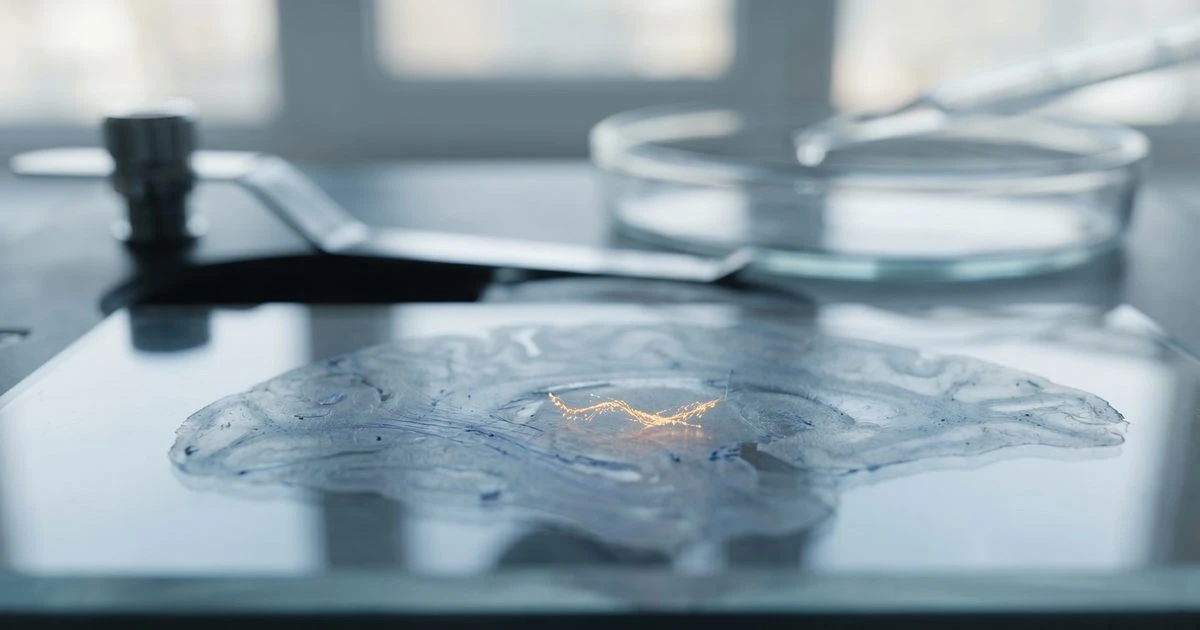
Brain tissue from people who died with advanced Alzheimer's disease carries a faint but measurable microbial signal, and one bacterium in particular keeps rising above the noise. A reanalysis of ribosomal-depleted RNA sequencing data from 17 post-mortem dorsolateral prefrontal cortex samples, published in the International Journal of Molecular Sciences in June 2026, identified Acinetobacter radioresistens as the only taxon to survive false discovery rate correction, enriched in Alzheimer's cases at a log2 fold change of 6.1. This is early, exploratory work with a small cohort, but the bacterium carries a structural protein that is worth paying close attention to.
Acinetobacter Radioresistens Enrichment in Alzheimer's Cortex
Researcher FX Guix Rafols re-examined publicly available RNA-seq data from the Mount Sinai Brain Bank cohort, a dataset of nine advanced Alzheimer's cases and eight controls. More than 99 percent of sequencing reads mapped to the human genome, leaving a thin sliver of microbial signal to work with. Using Kraken2 for taxonomic classification and edgeR for differential abundance testing, the analysis identified Acinetobacter radioresistens as significantly enriched in the Alzheimer's samples, with an FDR of 0.018. Several other taxa, including Actinomyces species and Staphylococcus warneri, showed suggestive differences in the same direction but did not survive correction for multiple comparisons. No statistically significant difference in the overall fraction of bacterial or viral reads separated AD from controls: it was the composition, not the total load, that shifted.
A. radioresistens is not a classic neurotropic pathogen. It is a gram-negative environmental and skin-associated organism, an opportunist rather than a dedicated brain invader. Its appearance here is notable less for its presence than for what it carries.
Amyloid-Forming Potential of a Surface Protein in A. Radioresistens
Guix Rafols performed an in silico investigation of an Ig-like domain-containing surface protein from A. radioresistens (accession XDO94130.1) that shows structural homology to Bap, the biofilm-associated protein found in several Acinetobacter species. The Waltz algorithm identified 42 distinct hexapeptide regions with high amyloidogenic propensity within the protein's N-terminal domain, and AlphaFold2 modeling predicted a beta-solenoid fold, the same architecture that characterizes functional bacterial amyloids. Critically, several of the predicted amyloidogenic patches are solvent-exposed, meaning they are geometrically available to interact with surrounding proteins rather than buried in the core.
This matters because of a phenomenon called cross-seeding. Bacterial functional amyloids can act as templates that accelerate aggregation of structurally similar host proteins. Research into amyloid beta as an antimicrobial protein has reframed the plaques of Alzheimer's disease not simply as toxic debris but as part of an innate immune response to microbial intrusion. If a bacterium with a Bap-like amyloidogenic surface protein is genuinely present in Alzheimer's cortex, cross-seeding becomes a mechanistically plausible connection between microbial exposure and amyloid pathology.
Why Post-Mortem Brain Microbiome Studies Are So Hard to Interpret
The single most important caveat here is contamination. Post-mortem brain is a low-biomass environment: the microbial signal is orders of magnitude smaller than what you would find in gut or oral samples. As contamination pitfalls in low-biomass studies have demonstrated in other contexts, reagent-borne microbes can easily mimic a biological signal in sequence-based studies that lack microbiome-specific negative controls. The current analysis did not include such controls, which means there is no formal way to model or subtract contamination from the results.
The study's other structural limits compound this concern: the cohort covers only nine AD cases, sampled from a single cortical region at an advanced disease stage. Low-biomass microbiome samples in pathology settings require careful handling and rigorous controls precisely because the ratio of signal to noise is so unfavorable. The in silico amyloid predictions are suggestive but provide no experimental evidence that the Bap-like protein actually interacts with amyloid beta or tau in living tissue. Microbial viability, metabolite production, and regional heterogeneity across the brain all remain unaddressed.
Where the Microbial Hypothesis of Alzheimer's Stands
This study lands in a larger and increasingly active conversation about whether microbes, from multiple body compartments, shape Alzheimer's risk and progression. The gut-brain axis connection to Alzheimer's is supported by a growing body of evidence linking gut microbial composition to neuroinflammation and cognitive decline. Work on gut microbiota's impact on microglia, the brain's resident immune cells, suggests that peripheral microbial signals can modulate the very cells that clear amyloid. Oral pathobionts such as Porphyromonas gingivalis, neurotropic herpesviruses, and now a skin-associated opportunist have all been implicated in AD tissue studies, pointing toward a model in which AD pathology is not triggered by a single microbe but shaped by a lifetime of immune encounters.
Actinomyces species, which showed suggestive enrichment in the AD group here, are common constituents of dental plaque and have appeared in prior incident AD associations. The coagulase-negative Staphylococcus warneri, also trending in AD samples, is an opportunist with known biofilm-forming capacity. Neither passed FDR correction in this dataset, but the pattern is consistent with what other lines of evidence suggest: that organisms capable of breaching barriers and forming biofilms may find a permissive environment in the aging, inflamed Alzheimer's brain.
What Validation Would Need to Look Like
The author frames the paper as explicitly exploratory, calling for targeted validation in independent cohorts using orthogonal assays. The immediate priorities are straightforward in principle: replicate the A. radioresistens enrichment in a larger, well-controlled post-mortem series that includes environmental and extraction blanks; test whether the Bap-like protein can cross-seed amyloid beta aggregation in cell-free or cell-based assays; and determine whether the organism or its nucleic acids are detectable in earlier AD stages or in accessible tissues like blood or cerebrospinal fluid.
Longer term, the microbiome-targeted Alzheimer's therapies under investigation, from probiotics and prebiotics to vaccination strategies and periodontal disease management, could eventually encompass interventions aimed at reducing opportunistic bacterial translocation across aging barriers. The antimicrobial protection hypothesis gives that idea mechanistic grounding. Whether Acinetobacter radioresistens is a causal player, an innocent bystander, or a reagent contaminant that happened to survive statistical correction is a question this single reanalysis cannot answer. What it does is put a specific bacterium, with a structurally interesting amyloid-forming protein, on the list of targets worth investigating.
Evidence rating
INVESTIGATIONAL — 65/100
Caveats:
- Extremely small cohort (9 AD cases, 8 controls) — severely underpowered for robust conclusions.
- Post-mortem brain is a low-biomass environment with no negative controls included, making it impossible to rule out reagent or laboratory contamination as the source of microbial signals.
- This is a retrospective reanalysis of an existing dataset, not a prospectively designed microbiome study.
- The amyloidogenic potential of the A. radioresistens protein is based entirely on computational prediction — no experimental evidence of interaction with Aβ or tau exists.
- Findings are restricted to advanced Alzheimer's disease in a single brain region and cannot speak to early disease or other brain areas.
- No funding was disclosed by the author.
Single-investigator retrospective reanalysis of an existing RNA-seq dataset (n=17 post-mortem brain samples). The study identifies one FDR-significant microbial association but cannot establish causation, and the authors explicitly acknowledge that contamination cannot be excluded due to the absence of microbiome-specific negative controls. Findings have not been replicated in an independent cohort.