Why Beans and Lentils Might Be Your Gut Bacteria’s Best Friend
A new narrative review pulls together years of research on pulses, beans, lentils, chickpeas, peas, soy, and lupin, and their effects on gut bacteria, cholesterol, blood sugar, and even the planet. Most of the detailed evidence is still preclinical, and the review says so.

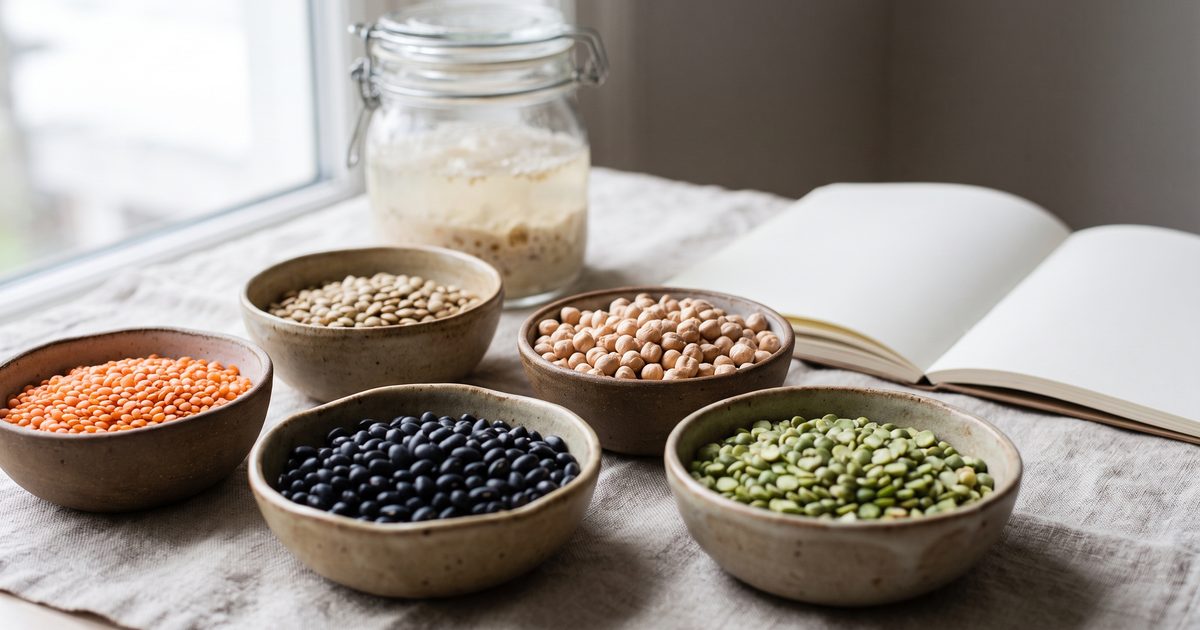
If you've been digging into what might be behind a stubborn gut issue, beans, lentils, chickpeas, and peas have probably already crossed your radar. A new review published in the journal Nutrients pulls together more than a decade of research on these foods, known collectively as pulses, and the pattern holds up study after study. The fiber, protein, and plant compounds in pulses feed the bacteria living in your colon, and that relationship shows up in measurable shifts in cholesterol, blood sugar, and inflammation. The honest part of the story is that most of the fine grained, mechanism level evidence still comes from animal and lab work rather than people, and the review says so plainly.
In short
- Pulses (beans, lentils, chickpeas, peas, soy, lupin) feed gut bacteria that produce short-chain fatty acids linked to a healthier gut lining and lower inflammation.
- The strongest human evidence comes from a 16-week trial in 127 people with prediabetes, showing drops in cholesterol, LDL, and blood sugar alongside beneficial shifts in gut bacteria.
- This is a narrative review summarizing existing studies, not a new experiment, and most of the detailed microbiome findings still come from animal and lab studies rather than people.
- Pulses also carry a far smaller environmental footprint than animal protein, producing roughly a tenth of the greenhouse gas emissions of beef per gram of protein.
Pulses Feed the Gut Bacteria That Make Short-Chain Fatty Acids
Pulses (the dried edible seeds of legumes, including beans, lentils, chickpeas, peas, soybeans, and lupin) carry fermentable fiber, resistant starch, and plant compounds called polyphenols that gut bacteria break down into short-chain fatty acids, or SCFAs (acetate, propionate, and butyrate, the fuel colon cells run on and a signal that helps hold the gut lining together). This isn't a single new experiment. It's a narrative review, meaning a team of researchers combed through years of existing studies, mostly published between 2015 and 2025, and synthesized what the field collectively knows rather than running a new trial themselves. That distinction matters for how much weight to put on any individual claim below.
Across the studies the review pulls together, pulses consistently nourish bacteria like Bifidobacterium and Faecalibacterium, both associated with a healthier gut lining and lower inflammation, while butyrate production rises alongside them. The Harvard T.H. Chan School of Public Health's Nutrition Source makes a similar point about legumes generally. The fiber and resistant starch they contain feed bacteria that produce butyrate, a short-chain fatty acid tied to lower rates of colorectal cancer.
Why This Matters If You Have IBS, Prediabetes, or High Cholesterol
The strongest human evidence in the review comes from a 16-week randomized trial of 127 people with prediabetes who added 100 grams of mixed pulses, beans and chickpeas, to a calorie-restricted diet each meal. Total cholesterol fell by about 7.5%, LDL cholesterol by about 8.5%, and HbA1c, a marker of average blood sugar over three months, by about 3.5%. Gut sequencing in the same trial showed increases in Bifidobacterium, Eubacterium rectale, and Roseburia, three genera repeatedly linked to a healthier gut, alongside a drop in Bilophila wadsworthia and Ruminococcus gnavus, bacteria more often tied to gut inflammation. A separate trial in 90 people with type 2 diabetes found that a white bean extract taken before meals lowered HbA1c by 0.71 percentage points while shifting gut bacteria toward more Bifidobacterium and Faecalibacterium. Readers managing IBS, IBD, prediabetes, or elevated cholesterol are exactly the population this evidence speaks to most directly, though none of it amounts to a treatment.
This Is a Review of Existing Studies, Not a New Experiment
It's worth stating this plainly. This paper does not report a new clinical trial. The authors searched PubMed, Scopus, the MDPI database, and Google Scholar for studies published mostly between 2015 and 2025, then organized what they found into a single narrative around pulses, gut microbiota, and metabolic health. The authors themselves flag this as a limitation. Because the review is not a systematic one, with predefined criteria and formal quality scoring, it is more vulnerable to selection bias than a systematic review or meta-analysis would be, and the studies it draws from differ widely in pulse type, dose, processing method, and study design. That is a normal tradeoff for narrative reviews. They are good at mapping a field broadly, less good at proving any single claim with certainty.
Pulses Also Cut the Environmental Cost of Getting Protein
Pulses show up in nutrition research and climate research at the same time, and the review leans into that overlap. Per unit of protein produced, pulses generate roughly one-tenth the greenhouse gas emissions of beef and require far less water, according to the life cycle assessments the review cites. A separate analysis of pulse crops published on PubMed Central put a sharper number on it, finding pulses produced roughly 0.44 kilograms of CO2 equivalent per 50 grams of protein, the lowest of any protein source measured, while also scoring well on nutrient density and cost per nutrient. Despite that, pulse consumption remains low in much of Europe. In Sweden, pulses supply only about 2% of daily energy intake, and in Denmark, a national dietary survey found that just 0.8% of the population meets the country's pulse recommendation.
What This Means If You're Watching Your Own Gut Health
None of this means swapping in a can of chickpeas will fix a gut issue on its own. What the review supports is more modest and more useful. Pulses are a food category with a reasonably strong, if uneven, evidence base for supporting gut bacteria diversity and several metabolic markers people commonly track when something feels off. If you're already working with a doctor on IBS, IBD, prediabetes, or cholesterol, it's a reasonable, low-risk thing to bring up. Cooking method matters too. Soaking, cooking, and especially fermenting pulses reduces compounds called antinutritional factors (natural plant compounds like phytates and tannins that can bind minerals and reduce absorption) while increasing the availability of the beneficial compounds discussed above. Whole, minimally processed pulses came out ahead of extracted or heavily processed pulse products throughout the review.
The Evidence Gap Between Animal Models and Human Trials
The review is candid about where its evidence gets thin. Most of the detailed findings on specific bacteria and SCFA production come from mice, rats, chickens, and lab dishes rather than people, and human trials that measure the gut microbiome directly, rather than just cholesterol or blood sugar, remain scarce. Pulse type matters too. Soy, chickpea, and lupin have more consistent supporting data across both animal and human studies, while faba bean and cowpea rest almost entirely on animal and lab evidence. A separate study in Frontiers in Microbiology that modeled digestion of eight pulse species underscores how uneven this can get. Some pulses promoted diversity and beneficial bacteria like Akkermansia muciniphila, while others, including chickpea, soybean, and black bean, increased Escherichia-Shigella, a less favorable genus, depending on each pulse's balance of carbohydrate, protein, and fat. The researchers behind the Nutrients review call for long-term, well-designed human trials with standardized doses as the clearest path to closing that gap.
Common Questions
Are pulses and legumes the same thing?
Not exactly. A legume is the whole plant, leaves, stems, and pods included. A pulse is specifically the dried edible seed, like a dried bean, lentil, or chickpea.
Do canned beans offer the same gut benefits as dried ones?
The review doesn't test canned versus dried pulses directly, but its findings center on whole, minimally processed pulses in general. Cooking and processing, rather than the can itself, is what changes nutrient availability.
How much fiber does eating more pulses actually add?
The review doesn't set a specific fiber target, but notes pulses run roughly 10 to 20% fiber by dry weight, and several countries recommend multiple servings a week, well above what most people in Europe currently eat.
Evidence Rating
EMERGING — 61/100
Caveats
- This is a narrative review pulling together existing studies rather than new experimental data, and the authors themselves flag its non-systematic search method as a limitation that can introduce selection bias.
- Most of the specific gut bacteria and short-chain fatty acid findings come from animal models (mice, rats, chickens) and in vitro lab digestion, not human studies; human microbiome data on pulses remain limited and inconsistent between trials.
- Human randomized trials support cholesterol and blood sugar benefits for some pulses, particularly mixed pulses, white beans, lupin, and soy, but trials measuring the gut microbiome mechanism directly are still scarce.
- Evidence strength is not uniform across pulse types: soy, chickpea, and lupin have more consistent supporting data, while faba bean and cowpea rest almost entirely on animal and lab evidence.
This is a narrative review, not a new study. It synthesizes findings from dozens of prior in vitro, animal, and human studies on pulses, beans, lentils, chickpeas, peas, soy, and lupin, and their effects on gut microbiota and metabolic health. Human randomized trials support certain cardiometabolic outcomes, including cholesterol and blood sugar improvements, for some pulse types, especially mixed pulses, white beans, lupin, and soy. Most of the microbiome-specific mechanisms, including which bacteria increase and how short-chain fatty acid production changes, are demonstrated mainly in animal and in vitro lab models rather than in people.
References
- Claudia E. Lazarte, Rucha Rane, Frida Hållenius, Olena Prykhodko (2026). Transitioning Towards Sustainable Diets: Pulses, Their Role in Modulating Gut Microbiota and Metabolic Health. Nutrients. https://doi.org/10.3390/nu18152571
- Legumes and Pulses – The Nutrition Source, Harvard T.H. Chan School of Public Health. nutritionsource.hsph.harvard.edu. https://nutritionsource.hsph.harvard.edu/legumes-pulses/
- Adam Drewnowski, Zach Conrad (2024). Pulse crops: nutrient density, affordability, and environmental impact. Frontiers in Nutrition. https://doi.org/10.3389/fnut.2024.1438369
- Da Bin Lee, In Seon Hwang (2025). Macronutrient balance determines the human gut microbiome eubiosis: insights from in vitro gastrointestinal digestion and fermentation of eight pulse species. Frontiers in Microbiology. https://doi.org/10.3389/fmicb.2024.1512217


