Your Gut Bacteria Might Be Turning a Western Diet Into a Cancer-Fueling Chemical
A new study in Gut ties deoxycholic acid, a bile-acid byproduct certain gut bacteria produce on Western-style diets, to colorectal tumor growth in pigs, mice, lab-grown human colon tissue, and stool data from over two thousand people.

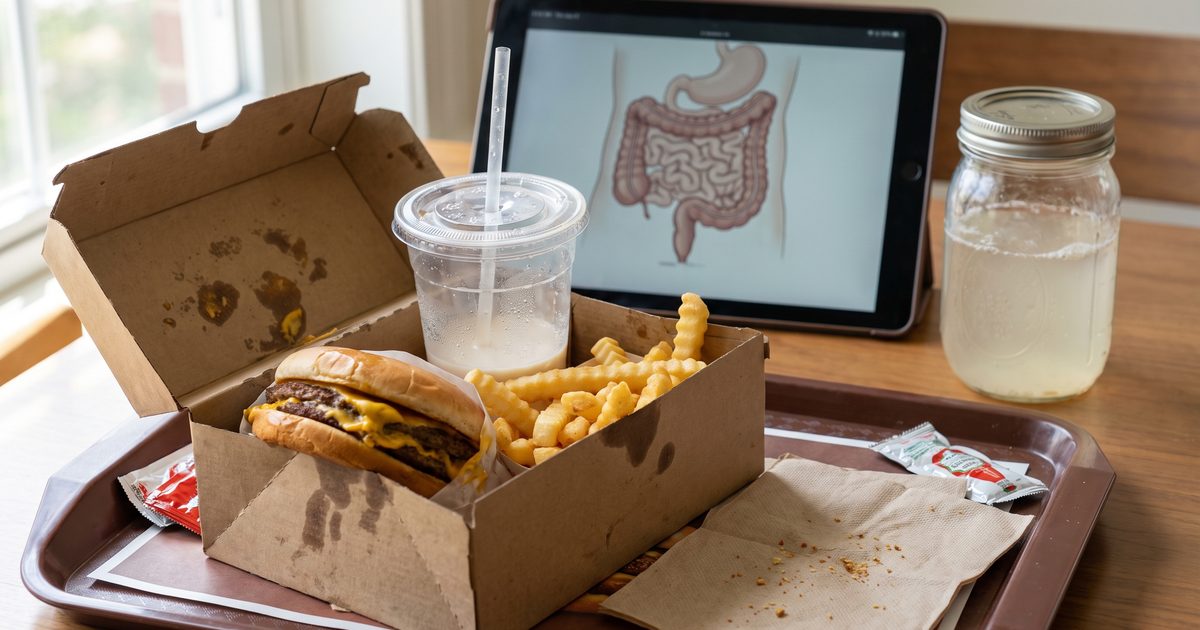
If you've ever wondered whether a diet heavy in fast food and red meat does more than add pounds, a new study offers a specific, testable answer for the colon. Researchers have identified a bile-acid byproduct that gut bacteria manufacture when people eat a Western-style diet, and shown, across pigs, mice, lab-grown human colon tissue, and stool samples from over two thousand people, that this molecule actively promotes tumor growth. It won't settle the broader "does diet cause colon cancer" debate, but it lays out one of the more complete mechanistic chains yet published connecting what's on your plate to what's growing in your colon.
Key takeaways:
- Gut bacteria that thrive on Western-style diets produce deoxycholic acid (DCA, a secondary bile acid made when bacteria chemically modify the bile your liver secretes to digest fat), and DCA promotes colon tumor growth in pig, mouse, and lab-tissue models.
- Genes that let bacteria make DCA turned up more often in the stool of 1,034 colorectal cancer patients than in 1,108 cancer-free controls, tying the mechanism to real-world disease patterns.
- The human evidence is observational, not proof that DCA causes cancer in people, and the animal experiments used pigs and mice already bred to be cancer-prone.
- No clinical trial has yet tested whether lowering DCA, through diet, medication, or otherwise, actually prevents colorectal cancer in humans.
Deoxycholic Acid: The Bile-Acid Byproduct Bacteria Make From Bile
Deoxycholic acid (DCA, a secondary bile acid created when certain gut bacteria chemically alter the bile your liver secretes to help digest fat) is the molecule at the center of a study published in Gut in August 2026, led by microbiologist Soren Ocvirk of the German Institute of Human Nutrition Potsdam-Rehbrucke. The team traced the chemistry to a specific bacterial process called 7-alpha-dehydroxylation, carried out by bile-acid-converting species including Clostridium scindens and Extibacter muris, detailed in the preprint version of the underlying research. In their models, DCA production accelerated tumor growth in animals already prone to developing it. Backing that up with human data, the researchers compared gut microbiome genes across stool samples from 1,034 people with colorectal cancer and 1,108 without it, and found genes tied to DCA production showed up more often in the cancer group. DCA's damage appears to run through several separate channels: past research on how deoxycholic acid damages colon cells has linked the molecule to DNA oxidative damage, mitochondrial dysfunction, and activation of the EGFR and Wnt/beta-catenin signaling pathways that drive abnormal cell proliferation.
Colorectal Cancer Risk and the Reach of a Western Diet
Anyone who regularly eats a diet heavy in red meat, processed food, and saturated fat is a candidate for the gut bacteria shift this study describes, since that eating pattern changes which bacterial species dominate the colon and how much bile acid they convert into DCA. The bile-acid theory of colorectal cancer risk is not a fringe idea either; a meta-analysis of 23 studies on fecal bile acids and colorectal cancer risk found DCA and three related bile acids were significantly elevated in people at high risk for the disease compared with low-risk groups, reinforcing that this new study fits into an existing, growing body of evidence rather than standing alone.
Pigs, Mice, and Human Tissue: How Researchers Tested the Mechanism
The research team built its case using four separate lines of evidence rather than one. Genetically modified pigs bred to be predisposed to colorectal tumors were fed different diets to see how DCA levels tracked with tumor severity. Gnotobiotic mice (raised germ-free, then deliberately colonized with defined mixes of bacteria) let researchers isolate the effect of DCA-producing species specifically, rather than the whole messy ecosystem of a normal gut. Lab-grown human colon tissue (organoids, miniature tissue structures grown from human cells) allowed direct testing of DCA's effect on human cells without exposing an actual patient. Layered on top of all three was the large-scale human stool metagenomics comparison. That combination, animal causation experiments plus a human association dataset, is what let the team argue for a mechanism rather than just a correlation.
What This Could Mean If You're Watching Your Own Gut Health
The honest takeaway is not "avoid Western food and you're safe," nor is it "get a microbiome test to check your DCA-producing bacteria." Neither a specific diet change nor any current microbiome test has been proven, in this study or elsewhere, to prevent colorectal cancer by targeting DCA. What this research does support is a more specific version of general dietary advice: the increased colorectal cancer risk long associated with red meat and processed food consumption may run partly through bacterially produced bile-acid metabolites, not just through the food itself. If you have a family history of colorectal cancer, unexplained digestive symptoms, or are simply curious about your risk, that's a conversation for a doctor and standard CRC screening guidelines, not a supplement aisle.
The Open Questions Researchers Haven't Answered Yet
The study has real limits the authors themselves acknowledge. The human arm is observational, meaning it shows an association between DCA-producing bacterial genes and colorectal cancer, not proof that the bacteria caused the cancer. The animal models, the pigs and mice, were disease-predisposed by genetic engineering, not standard representations of general-population risk. And critically, no human clinical trial has yet tested whether actually reducing DCA levels, whether through diet, a bile-acid-binding drug, or another method, prevents colorectal cancer from developing or progressing.
What Comes Next: Trials on Lowering Deoxycholic Acid
The researchers point to cholestyramine (a bile acid-binding drug already prescribed to lower cholesterol) as a plausible candidate for testing whether pulling DCA out of the gut affects cancer development, but they are explicit that no such trial has been run in humans yet. Until one is, DCA's role stays in the category of "a well-supported mechanism worth investigating" rather than "a proven target for cancer prevention."
Common Questions
What exactly is deoxycholic acid? It's a secondary bile acid, meaning it's not made directly by your liver but produced when certain gut bacteria chemically modify the primary bile acids your liver releases to help digest fat.
Does this mean eating fast food gives you colon cancer? No. The study shows a plausible mechanism and a human association, not proof that DCA causes cancer in any individual person; diet, genetics, and many other factors all contribute to colorectal cancer risk.
Should I ask my doctor about a microbiome test to check my DCA-producing bacteria? Not based on this research alone. No microbiome test or intervention aimed at DCA has been validated as a way to prevent colorectal cancer; standard CRC screening remains the evidence-backed approach.
How is this different from earlier bile-acid-and-cancer research? Earlier work mostly showed correlations between bile acid levels and cancer risk. This study adds animal experiments designed to test causation directly, alongside a large human stool-sample comparison, strengthening the case that the relationship isn't just coincidental.
Evidence Rating
EMERGING — 90/100
Caveats
- Human arm is observational
- Animal models disease-predisposed, not general-population
- No human trial yet tests whether reducing DCA prevents CRC
Combines large human cohort data with animal and lab-grown-tissue experiments to show a plausible mechanism; not yet tested in a human clinical trial.
References
- (2026). Following A Western Diet? Changes In Your Gut Bacteria Could Increase Colon Cancer Risk. https://www.healthandme.com/health-wellness/gut-bacteria-may-explain-why-western-diets-raise-colon-cancer-risk-study-finds-article-155322854
- Esther Wortmann, Annika Osswald, David Wylensek, et al. (2023). Secondary bile acid production by gut bacteria promotes Western diet-associated colorectal cancer. https://doi.org/10.1101/2023.03.17.533140
- Yujing Liu, Shengan Zhang, Wenjun Zhou, Dan Hu, Hanchen Xu, Guang Ji (2022). Secondary Bile Acids and Tumorigenesis in Colorectal Cancer. Frontiers in Oncology. https://doi.org/10.3389/fonc.2022.813745
- Shaohui Yang, Yu Wang, Lijuan Sheng, Wei Cui, Chenyang Ma (2025). The effect of fecal bile acids on the incidence and risk-stratification of colorectal cancer: an updated systematic review and meta-analysis. Scientific Reports. https://doi.org/10.1038/s41598-024-84801-6

