This Diet Pattern Raises Stomach Cancer Risk Six-Fold, Study Finds
A new 960-person case-control study found that inflammatory dietary patterns tracked with a six-fold increase in gastric cancer odds, while antioxidant-rich and gut-microbiota-friendly diets tracked with 75-80% lower odds.

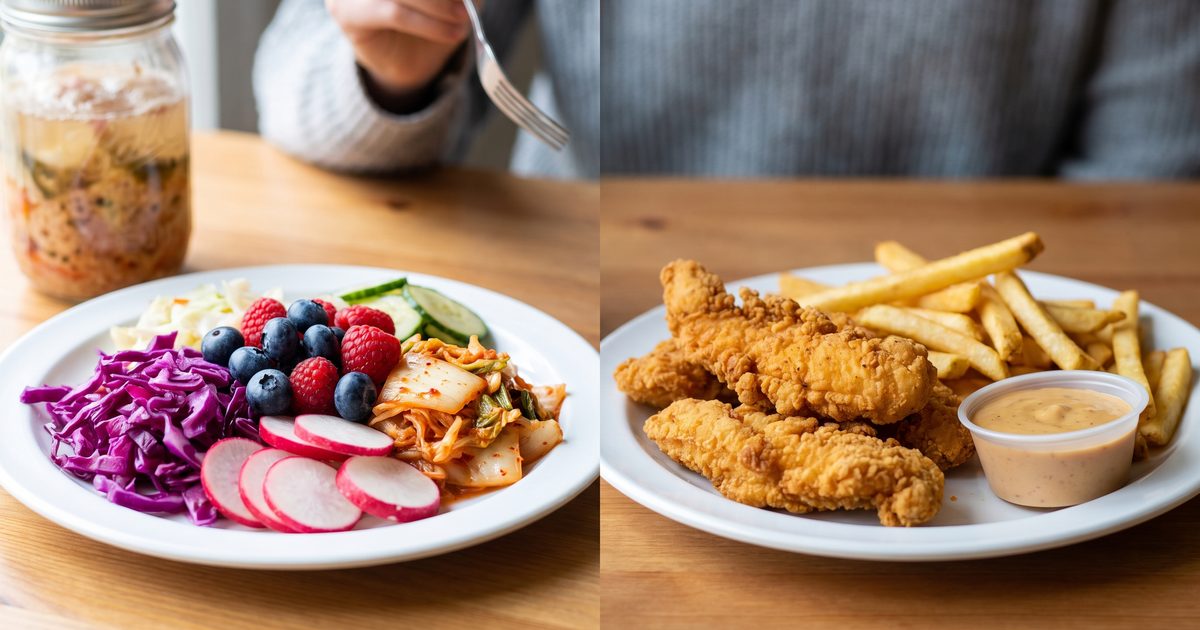
If you've been searching for why stomach pain, chronic indigestion, or a family history of stomach cancer keeps nagging at you, you've probably run into vague advice to "eat better for your gut." A new case-control study out of Shanxi Provincial Cancer Hospital in China puts real numbers behind that advice, at least for gastric (stomach) cancer. Researchers scored the everyday diets of 960 people, half with confirmed gastric cancer and half without, and found that how pro-inflammatory or antioxidant-rich someone's eating pattern was tracked with dramatically different odds of having the disease. The findings will not tell you exactly what to eat tonight, but they do sharpen which dietary signals are worth watching.
Key Takeaways
- People whose overall diet scored in the most pro-inflammatory third (tertile) had about 6 times the odds of having gastric cancer compared to those in the least inflammatory third.
- Diets richest in antioxidants and in nutrients that support gut bacteria were linked to 75-80% lower odds of gastric cancer.
- This is a case-control study of one hospital population in China using self-reported food questionnaires, so it shows an association, not proof that diet causes or prevents gastric cancer.
- None of the three diet scores predicted gastric cancer status with high precision on its own (AUC 0.63-0.71), so they are research tools, not diagnostic tests you could use on yourself.
Dietary Inflammatory Index Tracks a 6-Fold Jump in Gastric Cancer Odds
People in the highest third of scores on the Dietary Inflammatory Index (DII, a research score that rates how pro-inflammatory or anti-inflammatory someone's overall diet is, built from decades of nutrition literature) had about 6.21 times the odds of having gastric cancer compared to people in the lowest third (95% CI 4.39-8.79), according to a case-control study published in Frontiers in Nutrition. Higher DII scores also tracked with higher blood levels of CRP (C-reactive protein, a general marker of inflammation), TNF-alpha (a signaling protein that drives inflammation), MDA (a marker of oxidative cell damage), zonulin (a protein that loosens the tight junctions holding gut-lining cells together, used as a marker of gut barrier permeability), and NLR (neutrophil-to-lymphocyte ratio, a blood-based inflammation index). In the same dataset, two other diet scores moved the opposite way: people with the highest Composite Dietary Antioxidant Index (CDAI) scores had 80% lower odds of gastric cancer (OR 0.20, 95% CI 0.14-0.28), and those with the highest Dietary Index for Gut Microbiota (DIGM) scores had 75% lower odds (OR 0.25, 95% CI 0.18-0.35).
Why Stomach and Digestive Symptoms Deserve This Kind of Attention
Gastric cancer is not rare on a global scale. The World Health Organization counted roughly 1 million new stomach cancer cases in 2024, and it remains one of the more common causes of cancer death worldwide, partly because early symptoms (vague indigestion, mild stomach discomfort) are easy to dismiss. That matters most for people who already carry known risk factors: chronic gastritis, a history of Helicobacter pylori infection, or a family member with stomach cancer. The National Cancer Institute lists H. pylori infection and diets low in fruits and vegetables or high in salted, smoked, and preserved foods among the acknowledged risk factors for the disease. This new study adds a more granular layer: it is not just individual foods but a whole pattern, how inflammatory or antioxidant-rich a diet is overall, that tracked with risk in this dataset.
Inside the 960-Person Shanxi Case-Control Study
The researchers, led by Yongjing Chen and colleagues at Shanxi Provincial Cancer Hospital, enrolled 960 adults: 480 with histologically confirmed gastric cancer (meaning a pathologist examined tissue samples and confirmed the diagnosis under a microscope) and 480 controls without the disease. Everyone completed a food frequency questionnaire, and the researchers used those answers to calculate three separate diet scores, the inflammatory index, the antioxidant index, and the gut-microbiota index, then split each score into thirds (tertiles) to compare the highest-scoring group against the lowest. This case-control design, comparing people who already have a disease to people who do not, is a standard and efficient way to study a relatively uncommon cancer, but it looks backward at existing groups rather than following healthy people forward over time.
What the Findings Mean for Managing Your Own Diet
Nothing here proves that changing your diet will prevent or reverse gastric cancer, and nobody should read this as a prescription. What the study does offer is a more concrete vocabulary for a conversation with a doctor, especially if you have a family history of stomach cancer, a known H. pylori infection, or recurring digestive symptoms that concern you. The pattern that tracked with lower odds in this study, more antioxidants and more of the fiber and plant compounds that feed beneficial gut bacteria, overlaps heavily with general dietary advice already backed by other evidence: more fruits, vegetables, and whole foods, less reliance on salted, smoked, or heavily processed items. This study does not establish that pattern as a proven preventive intervention for gastric cancer specifically; it shows an association strong enough to be worth discussing, not a guarantee.
The Study's Case-Control Design Cannot Prove Causation
The authors themselves are explicit about this: a case-control design cannot establish that diet causes or prevents gastric cancer, only that the two are statistically associated. Several other limitations narrow how far the findings travel. The dietary indices were built from self-reported food questionnaires, which carry a real risk of recall bias, especially since cancer patients may remember their past eating habits differently than healthy controls do. The entire sample was drawn from a single hospital in Shanxi province, so the results may not generalize to other regions, diets, or health systems. And on their own, none of the three diet scores was a strong individual predictor of gastric cancer status; their discriminatory power (AUC, a 0 to 1 scale measuring how well a score separates cases from controls, with 0.5 being no better than a coin flip) ranged from a moderate 0.631 for the gut-microbiota index up to 0.712 for the inflammatory index.
Where Diet-and-Gastric-Cancer Research Goes From Here
The obvious next step is a prospective study, one that scores people's diets before any cancer diagnosis and follows them forward over years, which would go further toward testing whether these dietary patterns actually influence risk rather than merely correlating with it. The zonulin and short-chain-fatty-acid (SCFA, beneficial compounds gut bacteria produce when they ferment fiber) signals the researchers tracked alongside the gut-microbiota index also point toward mechanistic studies that could test whether gut barrier integrity and bacterial byproducts sit on the causal path between diet and stomach cancer, or are just markers riding alongside it. Until then, the broader public-health guidance on stomach cancer risk factors from MedlinePlus remains the more established starting point for anyone with concerns.
Common Questions
Does eating an anti-inflammatory diet prevent stomach cancer? This study cannot answer that. It found an association between a more pro-inflammatory eating pattern and higher gastric cancer odds in one hospital population, but a case-control design cannot show that changing your diet would lower your own risk.
What foods make a diet score as more inflammatory on the DII? The study itself does not list specific foods; it worked from a composite score built from decades of separate nutrition literature. In general terms, the categories that pull the score toward antioxidant and gut-friendly territory in this dataset (and in prior nutrition research) are fruits, vegetables, fiber, and whole foods rather than any single ingredient.
Is this the same as a genetic or family-history risk for stomach cancer? No. This study measured diet, not genetics. Family history remains a separate, well-established risk factor, and this study did not test how diet interacts with inherited risk.
How many people were in the study? 960 total: 480 with confirmed gastric cancer and 480 controls, all recruited through a single hospital in Shanxi province, China.
Evidence Rating
EMERGING — 76/100
Caveats
- Case-control design cannot establish causality (the authors’ own caveat)
- Single-hospital sample from Shanxi, China limits generalizability
- Dietary indices built from self-reported recall, so recall bias is a real risk
- Moderate standalone discriminatory power (AUC 0.63-0.71)
This is a single-center case-control study relying on self-reported diet; it shows strong associations between diet quality and gastric cancer risk but cannot prove diet directly causes the disease.
References
- Y Chen, R Yang, Q Song, Y Li, J Ma (2026). Inflammatory, Antioxidant, and Gut Microbiota–related Dietary Indices and Gastric Cancer Risk: a Case–control Study. Frontiers in Nutrition. https://doi.org/10.3389/fnut.2026.1893032
- Gastric Cancer Treatment (PDQ) – Health Professional Version. cancer.gov. https://www.cancer.gov/types/stomach/hp/stomach-treatment-pdq
- Stomach Cancer – MedlinePlus. medlineplus.gov. https://medlineplus.gov/stomachcancer.html


