Acupuncture Restored Gut Function in Parkinson’s Mice for Over 24 Hours
A new mouse study pinpoints the exact brainstem neurons behind Parkinson's-related gut trouble and shows a single acupuncture session can wake them back up for at least a day, though the finding is still mouse-only.

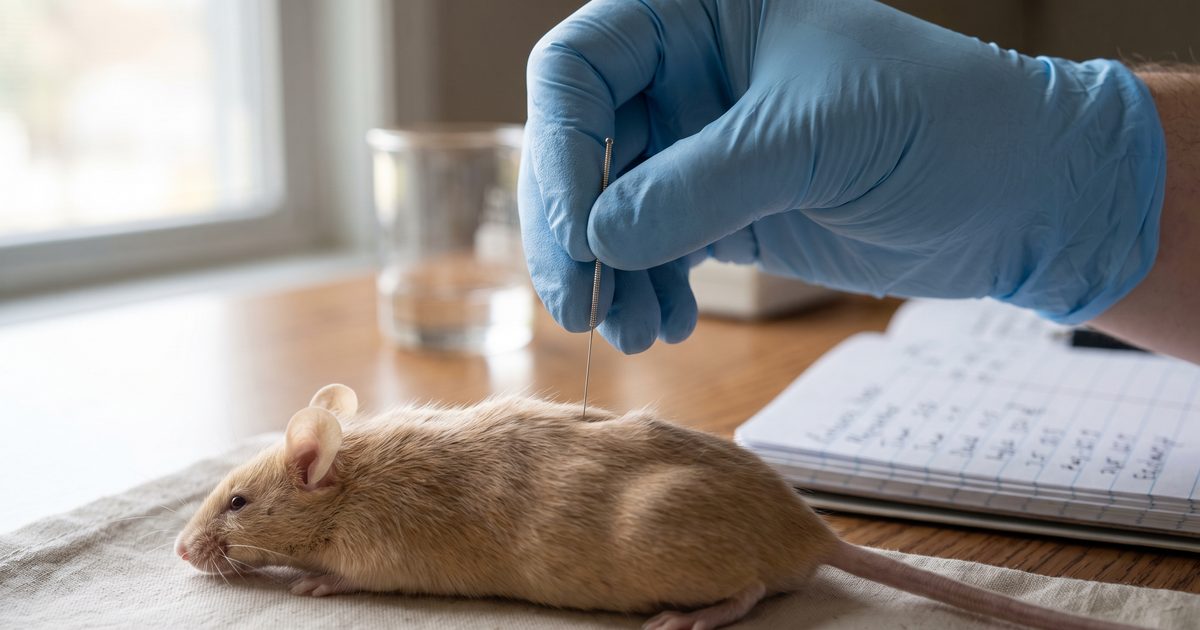
If you or someone you love has Parkinson's disease, there is a good chance the gut trouble showed up before the tremor did. Chronic constipation, a stomach that empties too slowly, and sluggish intestines affect a large majority of patients, and researchers have long suspected the cause sits in the nervous system rather than the gut itself. A mouse study published in Cell Reports by Yu and colleagues now identifies the specific brainstem neurons responsible, and shows that a single 30-minute session of electroacupuncture (acupuncture combined with a mild electrical current run through the needles) can switch those neurons back on for more than a day.
Key takeaways
- A mouse study in Cell Reports traces Parkinson's-related gut dysmotility (abnormally slow, uncoordinated movement of food through the digestive tract) to silenced neurons in a brainstem region called the dorsal motor nucleus of the vagus (DMV).
- A single 30-minute session of electroacupuncture at the ST36 acupoint reactivated those neurons and improved every gut-motility measure the researchers tracked, with the boost in nerve activity lasting at least 24 hours.
- The effect worked through a specific nicotinic acetylcholine signaling pathway and did not clear the underlying Parkinson's protein buildup, meaning it is a functional fix, not a cure.
- This is a mouse-only finding. No human trial of acupuncture for Parkinson's-related gut symptoms has been done.
Silenced Vagus Nerve Neurons Drive Parkinson's Gut Dysmotility
Parkinson's-related gut dysmotility traces back to a cluster of brainstem neurons called the dorsal motor nucleus of the vagus (DMV, the brainstem hub that sends the main nerve signals from the brain down to the gut). Using a newly built conditional mouse line, the researchers restricted a Parkinson's-linked mutant form of alpha-synuclein (the protein that clumps together and damages neurons in Parkinson's disease) to cholinergic neurons, the acetylcholine-producing nerve cells that make up the DMV's output, rather than the dopamine-producing neurons more commonly linked to Parkinson's. That was enough on its own to reproduce the full range of gut problems seen in the disease: reduced defecation, prolonged intestinal transit time, delayed stomach emptying, and weaker intestinal muscle propulsion. The effect was tightly localized to the brain region involved, too: the same mutation placed in an adjacent brainstem area produced no gut symptoms at all, pointing squarely at the DMV.
Electrical recordings showed why. DMV neurons carrying the mutant protein fired far fewer signals, a state the researchers call hypoexcitability (reduced ability of a neuron to fire). Using chemogenetics (a technique that lets researchers switch specific neurons on or off with a designer drug), the team went a step further and showed cause and effect directly: artificially silencing healthy DMV neurons reproduced the same gut dysfunction, while artificially reactivating impaired DMV neurons rescued gut function, in both a genetic mouse model and a second model built by injecting misfolded alpha-synuclein fibrils to mimic sporadic (non-inherited) Parkinson's.
Constipation Is an Early, Common Parkinson's Symptom
Gut dysmotility is one of the most common non-motor symptoms of Parkinson's disease, affecting an estimated 70% to 80% of patients, and it often shows up years or even decades before the tremors and stiffness that lead to diagnosis. That timeline lines up with the broader "gut-first" idea in Parkinson's research, in which alpha-synuclein pathology is thought to reach the brain via the vagus nerve rather than starting there. For anyone managing constipation, gastroparesis, or delayed digestion alongside a Parkinson's diagnosis, or watching for early warning signs in a family history of the disease, this study offers a concrete answer to a question that has lingered for years: not just that gut symptoms happen, but which neurons fail and why. It also matters practically, because sluggish gut transit can interfere with how well oral Parkinson's medications, including levodopa, are absorbed.
Two Mouse Models Confirmed the DMV-Gut Circuit Is Causal
The researchers used two complementary Parkinson's mouse models to make sure the finding was not a quirk of one system. The first was a genetic model, a newly developed conditional mouse line that expressed the A53T mutant form of alpha-synuclein (a mutation linked to inherited Parkinson's disease) only in cholinergic neurons. The second was a sporadic model, built by injecting preformed alpha-synuclein fibrils (misfolded protein "seeds" that trigger the same clumping seen in Parkinson's) directly into brainstem tissue. Across both models, the researchers combined patch-clamp electrical recordings, fiber photometry (a method for recording real-time activity in a specific group of neurons), viral tracing of nerve connections, and chemogenetic on/off switching to build a consistent picture: damaged DMV cholinergic neurons, not damaged gut tissue, are the root cause of the motility problems.
Acupuncture at ST36 Reawakened Gut Nerves for Over a Day
A single 30-minute session of electroacupuncture at the ST36 acupoint (a point below the knee already linked in prior research to vagus-nerve control of the stomach) increased activity in DMV neurons, using a 2-milliamp current, and the boost was still measurable in brain-slice recordings taken 24 hours later. That translated into meaningful improvement across every gut-motility measure the team tracked, in both the genetic and the sporadic mouse models. The researchers also pinned down the mechanism: blocking nicotinic acetylcholine receptors with either of two different drugs erased the benefit completely, tying the effect to the exact same cholinergic signaling pathway identified as damaged in the first place. Using viral tracing, they showed the physical wiring behind this: DMV cholinergic nerve fibers make direct contact with gut-wall neurons carrying the matching receptor.
One detail matters for how this should be read: electroacupuncture did not change how much of the harmful alpha-synuclein protein was present. It worked by functionally waking up surviving, still-wired neurons, not by clearing the underlying Parkinson's pathology. That is a meaningful distinction for anyone hoping for a disease-modifying treatment. This approach, if it ever reaches patients, would be aimed at a symptom, not the disease process driving it.
What Remains Unproven, and What This Cannot Yet Tell You
This is an entirely mouse-based study; no Parkinson's patient has been treated with this specific electroacupuncture protocol, and nothing here should be read as evidence that acupuncture, as generally practiced, treats Parkinson's-related constipation in people. The researchers themselves flag several open questions: whether different subtypes of DMV cholinergic neurons (grouped by which part of the gut they project to) respond differently to alpha-synuclein damage, whether neurons within the gut wall itself contribute independently to the dysfunction, and whether the exact acupuncture protocol used here, a specific current strength, point, and session length, would need to be substantially different to work in a human nervous system.
Where the Research Goes From Here
The next step the authors describe is systematically testing how intensity, frequency, session duration, and the interval between treatments affect the outcome, work needed before any version of this could be tested as a therapy in Parkinson's patients. There is at least a partial translational bridge already: a separate 2025 study in Neuron mapped how electroacupuncture at gastric-related acupoints engages comparable vagal circuitry in both mice and humans, which suggests the underlying wiring this new study relies on is not purely a mouse phenomenon. A formal clinical trial testing electroacupuncture specifically for Parkinson's-related gut symptoms has not been reported.
Common Questions
Does Parkinson's disease cause constipation? Yes. Gut dysmotility, including constipation, gastroparesis, and delayed intestinal transit, affects an estimated 70% to 80% of Parkinson's patients and frequently appears years before motor symptoms are diagnosed.
Can acupuncture treat Parkinson's-related constipation in people? Not yet established. The effect described here has only been shown in mice using a specific electrical acupuncture protocol at a defined point and dose; no human trial for this purpose has been reported.
What is the dorsal motor nucleus of the vagus (DMV)? It is a cluster of neurons in the brainstem that sends the main nerve signals controlling stomach and intestinal movement, and it is one of the earliest brain regions where Parkinson's-linked protein damage appears.
Does this treatment reverse the underlying Parkinson's disease process? No. In this study, electroacupuncture restored nerve activity and gut function without changing the amount of the damaging alpha-synuclein protein present, so it addressed the symptom rather than the disease itself.
Evidence Rating
INVESTIGATIONAL — 88/100
Caveats
- Mouse-only, human translation unconfirmed
Findings are from a mechanistic mouse-model study; effects in humans have not yet been tested.
References
Yu, M., Zhang, L., Zhang, X., Wu, A., Du, S., Luo, W., Du, Y., Li, Q., Chen, J., and Cao, P. (2026). Impaired brain-gut circuit for gut motility dysfunction in mouse models of Parkinson's disease. Cell Reports, 45, 117877. https://doi.org/10.1016/j.celrep.2026.117877
Dong, S., Zhao, L., Liu, J., Sha, X., Wu, Y., Liu, W., Sun, J., Su, Y., Zhuang, Z., Chen, J., et al. (2025). Neuroanatomical organization of electroacupuncture in modulating gastric function in mice and humans. Neuron, 113, 3243-3259. https://doi.org/10.1016/j.neuron.2025.06.023
New Understanding on the Pathophysiology and Treatment of Constipation in Parkinson's Disease. PMC. https://pmc.ncbi.nlm.nih.gov/articles/PMC9257174/