Daily Grape Powder Reshapes Gut Microbiome in Crohn’s Patients, Pilot Study Finds
Three weeks of daily grape powder quietly rewired the gut microbiome of Crohn's disease patients, boosting bacteria linked to reduced inflammation, even when standard disease markers held still.

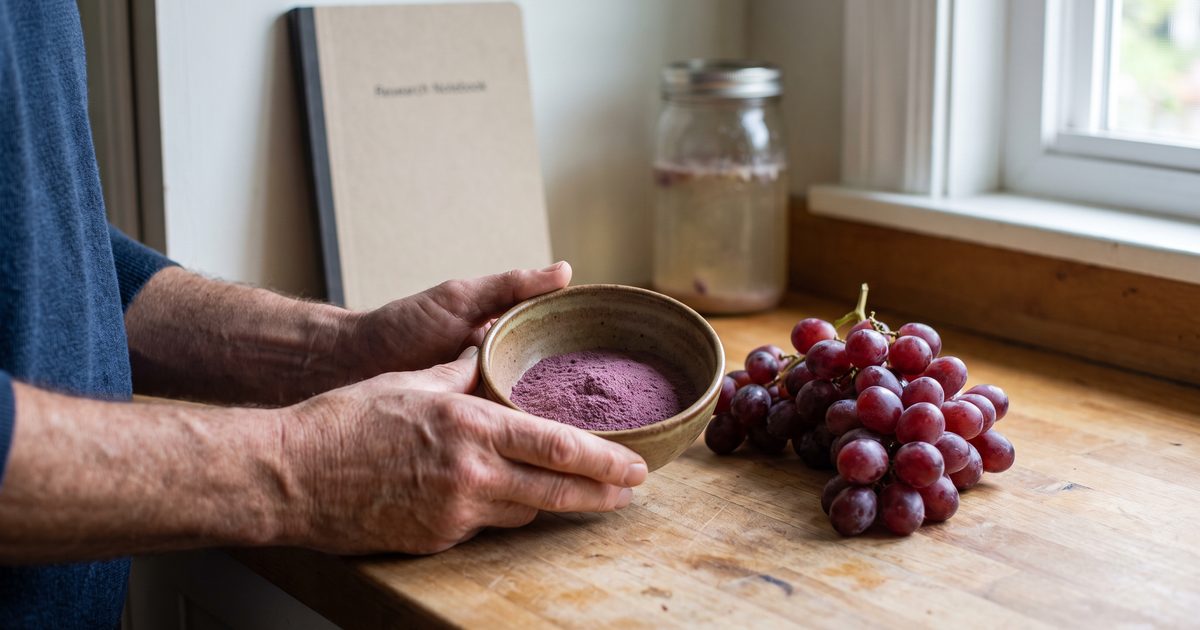
Three weeks of eating the equivalent of roughly 1.5 cups of fresh grapes per day produced measurable shifts in the gut microbiome of adults living with Crohn's disease, according to a small pilot study published in Nutrients in June 2026. The researchers, led by Eftekhar, Singh, Katz, and colleagues at a team that included Cominelli and Raffner Basson, found no significant movement in standard inflammation markers at the group level, but the microbial changes they catalogued point toward mechanisms worth pursuing in a larger trial.
Freeze-Dried Grape Powder Boosts Anti-Inflammatory Gut Species
Twenty-one adults with Crohn's disease completed the 21-day intervention, consuming 45 grams per day of freeze-dried grape powder (GP). Before enrolling, participants cleared all berries and berry-containing foods from their diets for seven days, reducing background polyphenol noise. At the phylum level, GP supplementation significantly enriched Bacteroidota and Verrucomicrobiota. At the family level, Akkermansiaceae, Bacteroidaceae, Tannerellaceae, Rikenellaceae, and Monoglobaceae all increased significantly. Akkermansia, the genus anchoring Akkermansiaceae, is frequently depleted in Crohn's disease and is broadly associated with a more intact intestinal lining; prior work on grape polyphenols and gut microbiome composition in animal models found similar enrichment of this taxon when oxidative stress in the gut was reduced. At the species level, 16 taxa shifted significantly, including a rise in Eubacterium eligens, a butyrate-producing bacterium that tends to be scarce in active inflammatory bowel disease. Butyrate feeds colonocytes and helps dampen the immune response in the gut lining, making its producing organisms a recurring target in dietary strategies for IBD.
Why These Microbial Shifts Matter for Crohn's Patients
Crohn's disease affects roughly 1 million people in the United States alone, and current therapies, while effective for many, leave a substantial proportion of patients without lasting remission. The microbiome is not a bystander in that struggle: an imbalanced microbial community contributes to the chronic intestinal inflammation that defines the disease. In this study, the functional character of the microbiome also changed between day 0 and day 21. Baseline fecal samples were enriched in pathways tied to bacterial structural components, including peptidoglycan maturation and LPS-associated processes, both linked to microbial virulence and gut inflammation in IBD. After 21 days on GP, those same samples shifted toward pathways for amino acid, polyamine, and vitamin biosynthesis, specifically arginine and polyamine metabolism and biotin biosynthesis, processes associated with epithelial repair and immune regulation. The pattern echoes cell-culture findings that grape polyphenols reduce inflammation and oxidative stress and can restore tight-junction integrity in human colon cells, suggesting the bacterial changes observed here may translate into a more protective gut environment.
How a 21-Day Open-Label Trial Was Designed and What It Measured
The team recruited from a pool of 700 contacted patients, enrolling those with confirmed Crohn's disease who were willing to maintain their existing medication regimens unchanged. Over three-quarters of completers, 76 percent, were already on immunosuppressive or biologic medications when they enrolled, meaning any signal in this study sits on top of a background of active pharmacological treatment. Primary outcomes focused on 16S rRNA amplicon sequencing of fecal samples collected at day 0 and day 21, processed through the CosmosID platform and the DADA2 algorithm. Secondary outcomes included body weight, the Harvey Bradshaw Index (HBI, a clinician-scored measure of CD activity where scores of 4 or below indicate remission), fecal myeloperoxidase (MPO, a neutrophil-derived enzyme that marks intestinal inflammation), and high-sensitivity C-reactive protein (hsCRP). None of those secondary markers moved significantly at the group level, though 61.9 percent of participants individually showed a reduction or no change in fecal MPO. Alpha diversity, measured by Shannon and Simpson indices, did show significant differences between pre- and post-intervention samples, even as the overall community structure on principal coordinates analysis remained relatively stable. As pilot studies are designed to assess feasibility rather than definitively test efficacy, the absence of a statistically significant clinical endpoint does not invalidate the microbial signal; it frames the question for a properly powered follow-up.
Key Limitations: No Control Group, Short Duration, Variable Diets
Several features of the study design limit what can be concluded. The trial ran for only 21 days, a window long enough to see microbial shifts but too short to determine whether those shifts would translate into clinical improvement. There was no placebo or control arm, so the possibility that factors outside the intervention drove some of the microbiome changes cannot be ruled out. Participants' diets beyond the grape powder were not standardized, introducing inter-individual variability that likely contributed to the range of individual responses. The open-label format also introduces the possibility of bias in self-reported outcomes. Finally, 16S rRNA sequencing identifies bacteria at the genus or species level based on a marker gene rather than whole genomes, which limits taxonomic resolution and means the functional pathway predictions from PICRUSt2 are inferred rather than directly measured. Those inferred pathways are hypothesis-generating, not confirmatory. The ongoing challenge of conducting well-controlled dietary trials in Crohn's disease is a broader obstacle this team will need to navigate in any follow-up work.
What a Larger Controlled Trial Would Need to Answer
The authors call for larger, longer, placebo-controlled studies to determine whether the microbial shifts seen here are durable and whether they correspond to reduced inflammation or improved clinical scores. A trial running 8 to 12 weeks with a matched control group consuming a calorie- and fiber-equivalent comparator would help isolate the contribution of grape polyphenols specifically. Standardizing background diet would reduce noise. The functional pathway data, particularly the enrichment in arginine and polyamine metabolism post-intervention, offers a mechanistic thread worth following: polyamines promote epithelial cell renewal, and their biosynthesis is often suppressed in inflamed intestinal tissue. As standardized, well-powered IBD dietary trials remain an active gap in the field, a grape powder study with a control arm and a longer horizon would add meaningful data to a literature that currently relies heavily on heterogeneous short-duration pilots. For now, the takeaway is cautious: daily freeze-dried grape powder appears safe and well-tolerated in Crohn's patients, and it reliably shifts the gut microbiome toward species associated with reduced intestinal inflammation, but whether that shift translates into clinical benefit remains an open question.
Evidence rating
INVESTIGATIONAL — 71/100
Caveats:
- Open-label pilot with no control group — cannot rule out placebo effect or natural disease fluctuation.
- Very small sample (n=21) drawn from a single center; results may not generalize.
- Only 21 days in duration — long-term effects on disease activity are unknown.
- No significant changes were detected in clinical disease activity (HBI), fecal MPO, or hsCRP at the group level.
- Most participants were on immunosuppressive or biologic medications, making it difficult to isolate the grape powder effect.
- Dietary intake outside the intervention was uncontrolled, adding variability.
- 16S rRNA sequencing provides limited taxonomic resolution and only inferred functional data.
Open-label single-arm pilot study in 21 adults with Crohn's disease. Without a control group, the observed microbiome shifts cannot be distinguished from spontaneous variation, dietary noise, or concurrent medication effects. No statistically significant changes were found in clinical disease activity or inflammatory biomarkers at the cohort level, and the findings have not been independently replicated.
References
- Mohammad Shahir Eftekhar, Drishtant Singh, Jeffry Katz, et al. (2026). Effect of Short-Term Grape Powder Supplementation in Patients with Crohn’s Disease: A Pilot Study. Nutrients. https://doi.org/10.3390/nu18121844
- Peter Kuhn, Hetalben M. Kalariya, Alexander Poulev, et al. (2018). Grape polyphenols reduce gut-localized reactive oxygen species associated with the development of metabolic syndrome in mice. PLOS ONE. https://doi.org/10.1371/journal.pone.0198716
- Paige E. Jamieson, Franck Carbonero, Jan F. Stevens (2023). Dietary (poly)phenols mitigate inflammatory bowel disease: Therapeutic targets, mechanisms of action, and clinical observations. Current Research in Food Science. https://doi.org/10.1016/j.crfs.2023.100521
- Definition & Facts for Crohn's Disease – NIDDK. NIH. https://www.niddk.nih.gov/health-information/digestive-diseases/crohns-disease/definition-facts
- Rameshprabu Nallathambi, Alexander Poulev, Joshua B. Zuk, Ilya Raskin (2020). Proanthocyanidin-Rich Grape Seed Extract Reduces Inflammation and Oxidative Stress and Restores Tight Junction Barrier Function in Caco-2 Colon Cells. Nutrients. https://doi.org/10.3390/nu12061623
- Andrew C. Leon, Lori L. Davis, Helena C. Kraemer (2011). The role and interpretation of pilot studies in clinical research. Journal of Psychiatric Research. https://doi.org/10.1016/j.jpsychires.2010.10.008
- Current Status, Challenges, and Future Directions in Crohn's Disease. mdpi.com. https://www.mdpi.com/2077-0383/12/16/5283
- Brigida Barberio, Luisa Bertin, Sonia Facchin, et al. (2025). Dietary Interventions and Oral Nutritional Supplementation in Inflammatory Bowel Disease: Current Evidence and Future Directions. https://doi.org/10.20944/preprints202504.1327.v1