Fungi, Viruses, and Archaea in Your Gut May Be Driving Obesity in Ways Bacteria Can’t Explain
Bacteria get most of the attention in gut microbiome research, but viruses, fungi, and archaea may be just as important in shaping who gains weight and who doesn't.

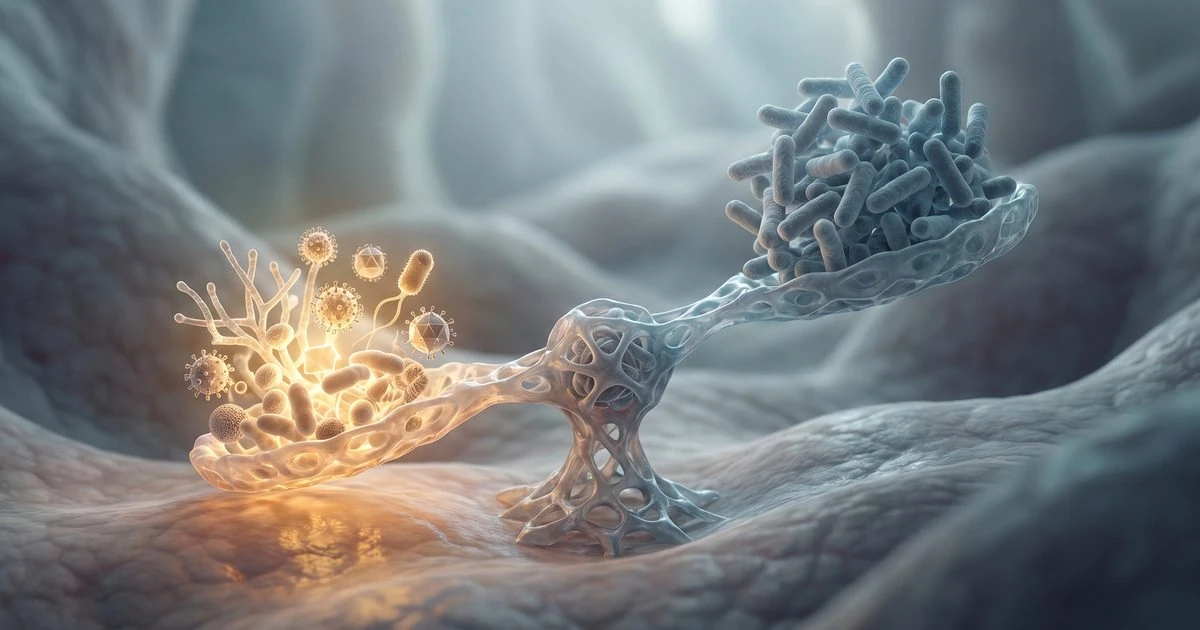
Bacteria have dominated gut microbiome research for decades, but a scoping review published in Molecular Metabolism suggests the conversation needs to widen. Viruses, fungi, and archaea, collectively the non-bacterial microbiome, appear to interact with gut bacteria in ways that meaningfully influence obesity and metabolic health. The authors argue these inter-kingdom relationships are no longer a footnote; they may be central to understanding why some people gain weight more easily than others.
Gut Virome Diversity Drops in Obesity, Mirroring Bacterial Patterns
The gut virome is far larger than most people realize: viruses outnumber bacteria by up to ten to one, with roughly 90% of them being bacteriophages, meaning viruses that infect bacteria rather than human cells. Obese individuals consistently show less virome diversity compared to lean controls, a pattern that mirrors the reduced bacterial diversity already associated with obesity.
One of the more striking findings involves crAssphages, the most abundant bacteriophages in the human gut. Rather than obliterating their bacterial hosts, crAssphages maintain a stable coexistence with Bacteroides intestinalis, regulating rather than eliminating host populations. In obese children, decreased crAssphage abundance tracks with an overabundance of Bacilli, bacteria in the Firmicutes phylum linked to greater caloric extraction. Fecal virome transplantation experiments in mice add a causal dimension: transferring the virome from lean mice to high-fat diet mice reduced weight gain and normalized glucose metabolism, an effect mediated indirectly through changes to the bacteriome rather than direct host interaction.
Human adenovirus 36 adds another layer. Seropositivity for Ad-36 is associated with increased BMI and total body fat mass, and the virus appears to promote increased glucose uptake, reduced leptin levels, and chronic low-grade inflammation, though establishing direct causality in humans remains difficult.
Mycobiome Composition, Not Just Diversity, Predicts Metabolic Outcomes
Fungi make up only about 0.1% of the total gut microbiome, dominated by Candida, Saccharomyces, and Cladosporium. Unlike the bacteriome and virome, fungal alpha diversity appears similar in lean and obese individuals. What differs is composition, and those compositional shifts may carry real metabolic weight.
Candida species are the most studied. They can break down complex polysaccharides, potentially altering short-chain fatty acid production, and some species appear to promote fat absorption and atherosclerosis. On the other side of the ledger, Saccharomyces boulardii, already used as a probiotic, has been shown in animal models to reduce hepatic steatosis, lower fat mass, and modulate the bacteriome in beneficial ways. Schizosaccharomyces pombe correlates with lean body composition in human studies and reduces weight gain and hepatic fat in high-fat diet mice while improving insulin sensitivity. Mucor species show a negative correlation with obesity and increase in abundance following weight loss.
These patterns suggest that fungi and archaea may shape gut health in ways that parallel their effects in other inflammatory conditions, though the review is careful to frame these as associations rather than confirmed mechanisms. The non-bacterial microbiome's role in disease is an area where research is genuinely in its early stages.
Methanobrevibacter smithii and the Caloric Extraction Problem
Archaea make up about 1% of the gut microbiome, and the dominant species is Methanobrevibacter smithii, a methanogen that produces methane by consuming hydrogen gas. That hydrogen would otherwise inhibit bacterial fermentation, so by removing it, M. smithii allows bacteria to extract more calories from dietary polysaccharides, a process called syntrophy.
When M. smithii colonizes the gut alongside Bacteroides thetaiotaomicron, the pairing increases caloric extraction and adiposity in mouse models. But the story is not straightforwardly negative. When M. smithii co-colonizes with Christensenellaceae, a bacterial family enriched in lean individuals, the outcome reverses: lower weight gain, elevated butyrate and propionate, and improved metabolic markers. The implication is that M. smithii is neither inherently obesogenic nor protective; its effect depends entirely on which bacterial partners are present.
One practical angle emerges from this: methane breath testing, which detects methanogen activity non-invasively, could serve as a prognostic tool for identifying patients who might respond differently to dietary interventions or weight-loss treatments. The authors note this potential but stop short of recommending it for clinical use.
Methodological Gaps That Limit What We Can Conclude
A recurring theme in the review is how technically difficult these non-bacterial communities are to study. Reference databases for the virome remain incomplete, making it hard to identify viruses below the order level. DNA extraction protocols developed for bacteria perform poorly on fungi and archaea. Archaea are especially challenging: their low abundance, DNA extraction biases, and resistance to culturing in the lab mean many findings rest on a thin evidence base.
The review also flags confounding. Geographic factors, diet, water quality, and psychological stress all influence the gut virome and likely the mycobiome and archaeome as well. Current microbiome study methods have well-documented gaps for non-bacterial organisms, and without better reference genomes and culture systems, causal claims will remain difficult to substantiate. Even the finding that small intestinal microbiome profiles correlate better with obesity than stool samples, an important methodological point, has not been systematically exploited in this research area.
What Broader Inter-Kingdom Research Could Unlock
The most forward-looking section of the review concerns inter-kingdom interactions, the cross-feeding and competitive dynamics that link viruses, fungi, archaea, and bacteria into a single functional ecosystem. Phage-bacteria interactions follow what researchers call a "piggyback the winner" model, where phages delay lysis and enter lysogeny when their bacterial hosts are thriving. Antibiotic treatment disrupts this balance, reducing bacteriome diversity while increasing virome diversity through generalized lysis. Caloric restriction moves the system in the opposite direction, increasing bacteriome evenness while phages shift toward lysogeny.
Research into fungi and archaea in inflammatory gut conditions like Crohn's disease suggests these inter-kingdom effects may be even more pronounced in disease states, pointing toward therapeutic targets that go beyond probiotic bacteria. For obesity specifically, the authors suggest that future interventions may need to target the full microbial ecosystem rather than any single species or kingdom. Whether that means virome-targeted therapies, fungal modulation, or archaea-specific approaches remains an open question, but the review makes a credible case that ignoring three-quarters of the gut microbiome may be part of why obesity remains so hard to treat.
Evidence rating
EMERGING — 80/100
Caveats:
- This is a scoping review synthesizing existing literature, not a new experimental study — it cannot establish causation.
- Much of the mechanistic evidence comes from murine models and observational human data; direct causal links in humans remain unproven.
- Reference databases for the virome and archaeome are incomplete, limiting taxonomic precision across the studies reviewed.
- Funding source was not disclosed by the authors.
Scoping review synthesizing murine transplant experiments, human cross-sectional studies, and mechanistic data across the gut virome, mycobiome, and archaeome. Findings are largely associative or derived from animal models, and causal relationships in humans have not been established. The underlying primary studies vary in design quality, and incomplete reference databases for non-bacterial microbiome components limit taxonomic resolution; independent large-scale human replication is lacking for most claims.

