How Gut Bacteria Drive PCOS Risk Through Metabolites and Immune Signals
New genetic evidence suggests the gut microbiome may shape PCOS risk not directly, but through a cascade of circulating metabolites and immune signals, mapping 47 distinct biological pathways between bacteria and one of women's most common hormonal disorders.

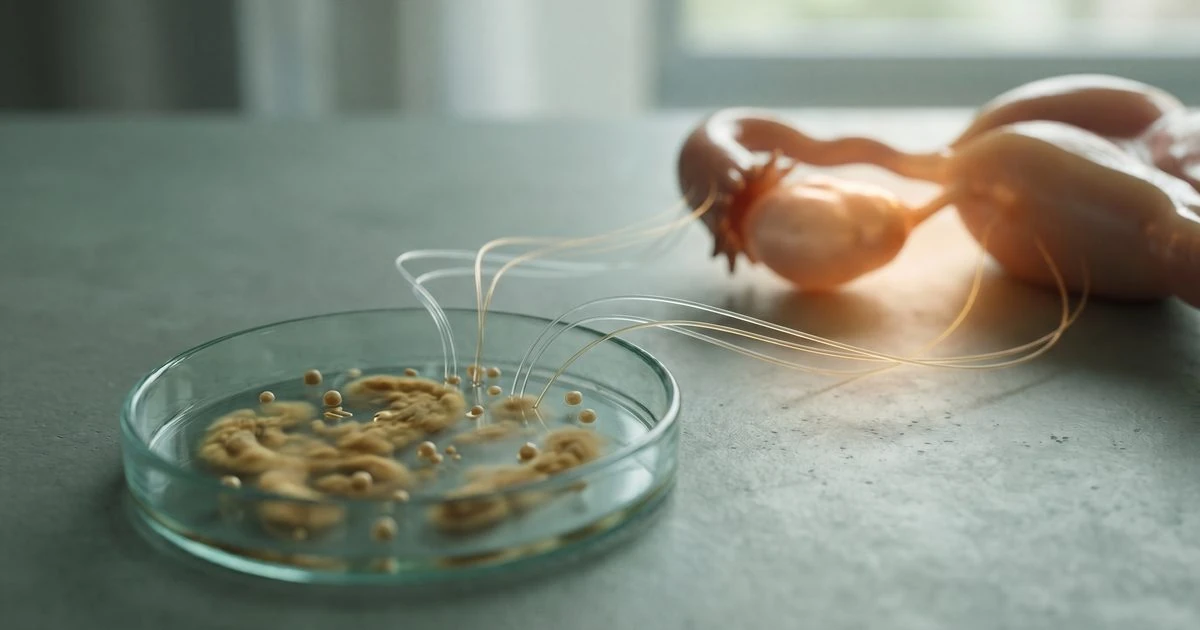
Polycystic ovary syndrome affects between 5% and 10% of women of reproductive age, making it one of the most common hormonal disorders in the world. Researchers have long suspected that gut bacteria play a role, but pinning down whether that relationship is causal, and identifying exactly how bacteria influence the ovaries, has proven difficult. A new study published June 10, 2026, by Li Y, Zhang Y, Liu W, and Tao T uses Mendelian randomization to trace those causal threads, identifying 11 bacterial taxa, 124 plasma metabolites, 45 immune cell types, and 5 inflammatory proteins as players in the gut-to-PCOS pathway.
11 Gut Bacterial Taxa Causally Linked to PCOS Risk
The study draws on publicly available genome-wide association study data and applies a two-step Mendelian randomization mediation framework, a design that uses genetic variants as natural proxies for exposures to sidestep the confounding that plagues observational research. The first analytical step identified causal effects of specific gut microbial taxa on circulating metabolites, immune cells, and inflammatory proteins. The second estimated how those intermediaries then influenced PCOS risk. The primary model was the Inverse Variance Weighted method, corroborated by MR-Egger, weighted median, and MR-PRESSO sensitivity analyses.
Of the 11 intestinal flora taxa that showed causal impacts on PCOS, four were associated with increased risk: Class Betaproteobacteria, Genus Eubacterium eligens group, Genus Ruminiclostridium6, and Order Burkholderiales. Seven taxa suggested potential protective effects: Family Bifidobacteriaceae, Genus Bilophila, Genus Holdemania, Genus Hungatella, Genus Ruminococcaceae UCG004, Genus Veillonella, and Order Bifidobacteriales. The protective signal from Bifidobacteriaceae and Bifidobacteriales is consistent with broader evidence linking gut dysbiosis to PCOS progression, where microbial imbalance disturbs hormonal regulation and amplifies hyperandrogenism, one of PCOS's defining features.
Androgenic Steroids and Branched-Chain Amino Acids as Key Metabolic Mediators
The most striking finding may be the scale of the metabolite map the team assembled. Of 124 plasma metabolites causally linked to PCOS, those involved in androgenic steroid metabolism, branched-chain amino acid metabolism (specifically leucine, isoleucine, and valine), glutathione metabolism, and secondary bile acid metabolism were prominently represented. That last pathway is worth noting: gut microbiota imbalance is known to alter short-chain fatty acid content and bile acid signaling in PCOS patients with insulin resistance, suggesting a plausible mechanism through which bacteria shift metabolic chemistry upstream of the ovaries.
Mediation analysis traced 34 distinct pathways in which circulating metabolites served as the bridge between gut microbial taxa and PCOS. The androgenic steroid connection is particularly salient: bacteria that alter bile acid recycling can also modulate sex hormone metabolism, potentially explaining why gut composition correlates with the testosterone excess characteristic of PCOS.
How Immune Cells and Inflammatory Proteins Carry the Signal
Beyond metabolites, the study found that 45 circulating immune cell types and 5 inflammatory proteins showed causal effects on PCOS. Mediation analysis identified 13 distinct pathways in which immune cells or inflammatory proteins served as intermediaries between gut flora and PCOS, bringing the total count of mapped indirect pathways to 47. This immune dimension matters because PCOS is increasingly understood as a chronic low-grade inflammatory condition, not simply a reproductive one. The finding that specific bacterial taxa can shift immune cell populations in ways that feed back into PCOS pathology adds a layer of biological specificity to that picture.
Limitations of Mendelian Randomization in This Context
Mendelian randomization is powerful precisely because genetic variants are assigned at conception, before any exposure, making reverse causation less plausible. But the method carries its own constraints. The GWAS data underlying the analysis are population-level summaries, not individual patient records, so the study cannot confirm whether these pathways operate uniformly across PCOS subtypes or ethnic groups. The causal estimates also depend on assumptions about genetic instrument validity that cannot be fully verified. As one recent review notes, understanding how the gut microbiota influences PCOS remains limited and will require experimental and clinical work to move from statistical association to actionable mechanism. The 47 pathways identified here are hypotheses with genetic support, not proven clinical levers.
Microbiome-Targeted Therapies for PCOS Move Closer to Rationale
The practical value of mapping these pathways is that it narrows the search space for intervention. If Bifidobacteriaceae exerts a protective effect through secondary bile acid metabolism, for instance, probiotic strategies targeting that genus become more rationally grounded. Research into microbiome-based PCOS therapies, including probiotics, prebiotics, synbiotics, and fecal microbiota transplantation, is already underway, and separately, dietary interventions that shift gut microbiota composition have shown early promise for improving insulin sensitivity and lowering androgen levels in PCOS patients. The specificity this study adds, naming taxa, metabolites, and immune cell types rather than gesturing at the microbiome in general, could help researchers design trials with clearer mechanistic targets.
For now, the findings from Li and colleagues represent a substantial step in characterizing the biological architecture between gut bacteria and PCOS. Whether the 47 pathways they identified will eventually translate into diagnostics or treatments depends on the clinical studies that must follow.
Evidence rating
EMERGING — 90/100
Caveats:
- Mendelian randomization uses genetic proxies to infer causality — it is not a clinical trial, and results require replication in prospective or interventional studies before clinical application.
- All data derive from GWAS summary statistics, not individual patient data; population heterogeneity and unmeasured confounders may influence estimates.
- Funding source was not disclosed by the authors, limiting full assessment of potential conflicts of interest.
- This is a single study and has not yet been independently replicated.
Two-step Mendelian randomization study using publicly available GWAS summary statistics to infer causal relationships between gut microbial taxa, circulating metabolites, immune cells, and PCOS. MR can support causal inference but relies on genetic instruments as proxies and cannot replace direct experimental evidence; residual pleiotropy and population-specific effects remain possible. The findings have not yet been independently replicated in a separate cohort or interventional study.