A Three-Supplement Stack Cut Sprint Decline by Half in Professional Football Players
Adding phosphatidylserine to a caffeine-taurine supplement cut sprint decline nearly in half during a professional football training session, and lifted passing accuracy to 84 percent. The findings are preliminary, but the effect sizes are hard to ignore.

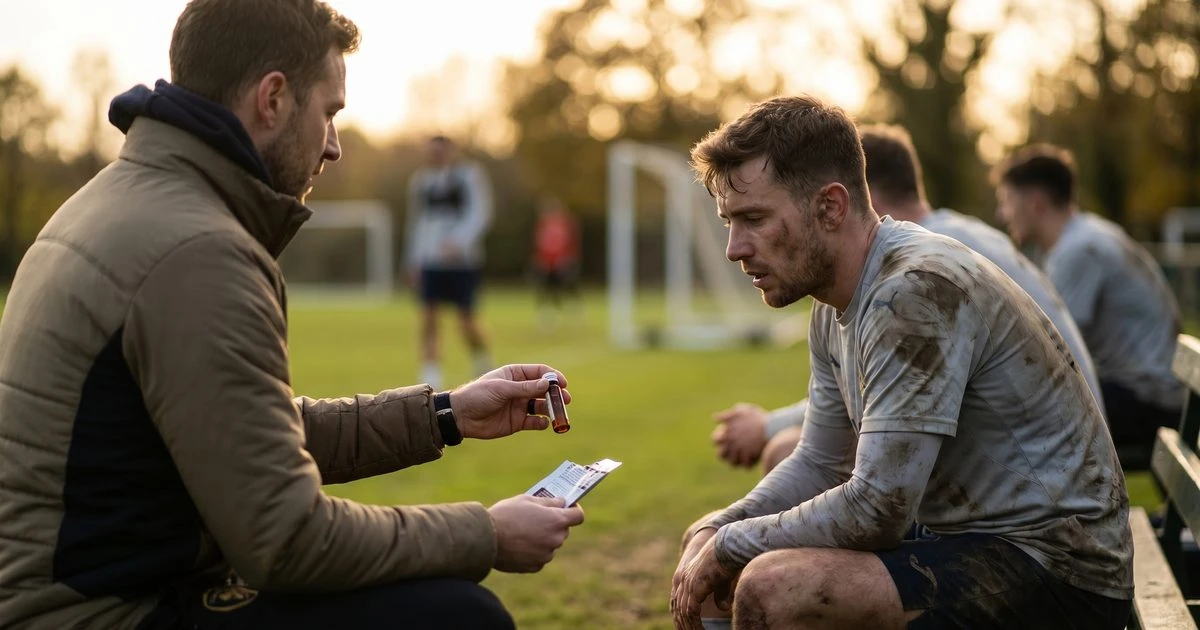
Sprint performance in professional football tends to fall off sharply in the second half of a match. A new randomized study published in Nutrients suggests that a three-ingredient supplement stack, combining taurine, caffeine, and phosphatidylserine, may blunt that decline significantly, while also sharpening the cognitive edge players need to make fast, accurate decisions under fatigue.
Sprint Decline Drops From 34% to 18% With Triple Supplement Stack
The study by Mizera and colleagues recruited 81 professional male footballers from Poland's second division and split them into three groups: placebo, taurine plus caffeine (TC), and taurine plus caffeine plus phosphatidylserine (TCP). After 10 days of supplementation, each group completed a standardized 105-minute training session monitored by GPS devices. The TCP group took 1,500 mg taurine, 150 mg caffeine, and 300 mg phosphatidylserine; the TC group took 1,500 mg taurine and 200 mg caffeine; all doses were consumed 60 minutes before the session.
The headline result: sprint performance declined by only 18% in the TCP group across the second half of training, compared to 34% in the placebo group. Effect sizes throughout were described as large to huge (p < 0.001). GPS-derived metrics, including total distance covered, maximal speed, and sprint counts, were all significantly higher in TCP versus placebo as well.
Passing Accuracy and Decision-Making Also Improved
Physical output was only part of the picture. TCP players finished the session with a passing accuracy of 84%, compared to 75% in the placebo group. Dribbling success followed the same pattern: 73% versus 62%. Coaches evaluated technical and tactical performance through video analysis, and rated the TCP group higher across the board, including positioning, off-ball movement, decision-making, and support play.
Visual and auditory reaction times were also shorter in the TCP group. That matters because elite football players show superior executive function and decision-making compared to the general population, and those cognitive traits predict key on-field behaviors. When fatigue erodes reaction speed, it erodes football intelligence along with it. The data here suggest the TCP stack helped preserve both.
The taurine-caffeine combination on its own showed meaningful benefits relative to placebo, consistent with earlier work showing that combined caffeine and taurine improve reaction time and agility in elite boxers. But for fatigue-related sprint decline and most coach-rated tactical scores, the TCP group pulled clearly ahead of TC, suggesting phosphatidylserine added something the two-compound stack could not supply on its own.
How Phosphatidylserine May Support Performance Under Fatigue
Phosphatidylserine is a phospholipid found in neuronal membranes and plays a role in their structural integrity. Prior research has found that PS supplementation can improve cognitive function around resistance exercise in young males, which aligns with the theory that it reduces exercise-induced cortisol responses and perceived fatigue. In football, where cognitive load peaks precisely when the body is most tired, a compound that buffers central fatigue could carry outsized value.
Caffeine, for its part, works via adenosine receptor antagonism, keeping players alert and speeding processing time. Taurine acts as a neuromodulatory compound whose independent cognitive effects are modest, but which may modify how the body responds when combined with caffeine. The authors hypothesized going in that the triple combination would outperform the two-compound protocol, and on most measures that prediction held.
Key Limitations to Keep in Mind
This is exploratory, hypothesis-generating research, and several design issues deserve honest acknowledgment. The study was single-blind: players did not know which supplement they received, but some investigators did. That creates a risk of expectancy bias, particularly in the coach-rated outcomes, which were partly subjective. Inter-rater reliability for coaching evaluations was not formally assessed.
There is also a confound built into the dosing protocol. The TC group received 200 mg of caffeine while the TCP group received only 150 mg. That 50 mg difference means the two groups are not directly comparable: any superiority of TCP over TC could reflect the phosphatidylserine, a lower caffeine dose interacting differently, or some combination of the two. Isolating the independent contribution of phosphatidylserine is not possible from this data alone.
No biochemical markers, such as cortisol or blood lactate, were measured, so the physiological mechanisms remain speculative. No a priori sample size calculation was reported, which is a standard indicator that findings should be treated as preliminary. Reviewers of supplement research in elite athletes have noted these kinds of gaps affect direct comparisons across studies and make firm conclusions difficult.
What Comes Next for Multi-Ingredient Sports Supplements
The authors call for double-blind, pre-registered studies with matched caffeine doses and objective performance measures, including biochemical markers, to confirm and clarify these results. That is the right standard. What this study contributes is a plausible, well-powered signal in a professional cohort that is genuinely difficult to recruit and study: second-division footballers completing controlled training under GPS monitoring is closer to real-world conditions than most laboratory ergogenic trials.
The practical question for coaches and sports scientists is whether a phosphatidylserine layer on top of a caffeine-taurine base is worth testing in their own programs. Based on this data, the answer is a cautious maybe. The effect on sprint fade and cognitive accuracy in the second half of a training session is real and large enough to be relevant. Whether it survives a more rigorous blind design with matched doses is the experiment that still needs to happen.
Evidence rating
INVESTIGATIONAL — 76/100
Caveats:
- The TC and TCP groups received different caffeine doses (200 mg vs. 150 mg), making it impossible to isolate phosphatidylserine's independent contribution.
- Single-blind design with no a priori power calculation; the study is explicitly exploratory.
- Technical and tactical outcomes relied partly on subjective coach ratings; formal inter-rater reliability was not assessed.
- No biochemical markers were measured, so proposed mechanisms (cortisol attenuation, membrane integrity) remain unverified.
- Funding was not disclosed by the authors.
Randomized, placebo-controlled, single-blind trial in 81 professional male football players (n=27 per group). Shows associations between a taurine-caffeine-phosphatidylserine protocol and improved sprint, reaction-time, and coach-rated tactical outcomes, but unequal caffeine dosing between the two active arms prevents attribution of effects to phosphatidylserine specifically. The authors classify the analysis as exploratory; findings have not been independently replicated.
References
- Krzysztof Mizera, Elżbieta Mizgała-Izworska, Justyna Mizera, Jan Mackiewicz (2026). Effects of Taurine-, Caffeine-, and Phosphatidylserine-Containing Supplementation Protocols on Physical and Cognitive Performance in Professional Male Football Players. Nutrients. https://doi.org/10.3390/nu18111684
- Higher-level cognitive abilities are linked to elite sport performance in football players. PNAS. https://www.pnas.org/doi/10.1073/pnas.2215351120
- Murat Ozan, Yusuf Buzdagli, Cemre Didem Eyipinar, et al. (2022). Does Single or Combined Caffeine and Taurine Supplementation Improve Athletic and Cognitive Performance without Affecting Fatigue Level in Elite Boxers? A Double-Blind, Placebo-Controlled Study. Nutrients. https://doi.org/10.3390/nu14204399
- Adam Parker, Josh Gordon, Aaron Thornton, et al. (2010). The effects of phosphatidylserine supplementation on cognitive functioning prior and following an acute bout of resistance training in young males. Journal of the International Society of Sports Nutrition. https://doi.org/10.1186/1550-2783-7-s1-p2
- Tongwu Yu, Chuanwei Ding (2025). Efficacy of dietary supplements on sports performance outcomes: a systematic review of evidence in elite athletes. Frontiers in Nutrition. https://doi.org/10.3389/fnut.2025.1675654