Taking Vitamin C After Nitrate-Heavy Meals Could Cut Your Cancer Risk, Math Model Suggests
Bacon and spinach both contain nitrates, yet one gets cancer warnings and the other a nutrition halo. A new mathematical model may finally explain why, and the answer could change how you time your vitamin C intake.

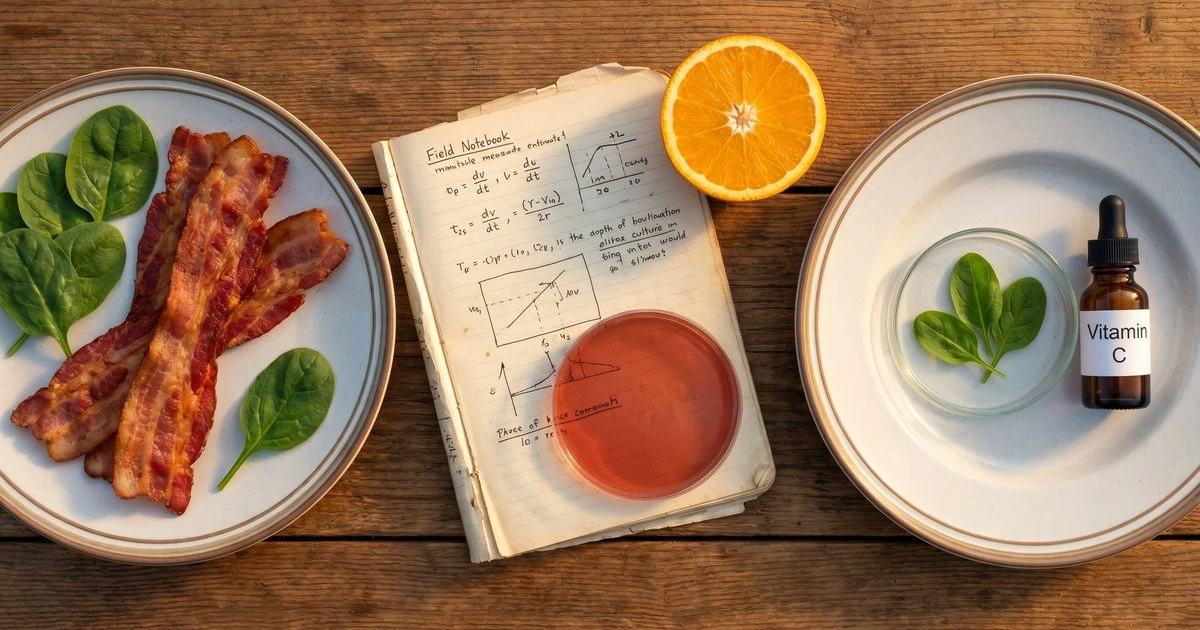
Bacon and spinach both contain nitrates, yet nutritionists have long treated them as opposites when it comes to cancer risk. A new study published in the Journal of Theoretical Biology suggests the difference comes down to a single molecule: vitamin C, and whether it arrives in your stomach at the same time as the nitrates. The findings are preliminary, based on a computer simulation rather than a clinical trial, but they offer the clearest mechanistic picture yet of how diet and timing interact to shape gastric cancer risk.
How nitrosation turns everyday food compounds into potential carcinogens
Nitrates and nitrites are ubiquitous. They appear as preservatives in cured meats, occur naturally in leafy and root vegetables, and can leach into tap water from agricultural runoff. In small doses they support blood vessel function and nerve signaling, which is why the nutrition picture has been so confusing. The problem starts in the stomach, where nitrites can react with food proteins in a process called nitrosation, producing N-nitroso compounds (NOCs). Several NOCs are suspected carcinogens associated with gut tumors, and research into vitamin C's broader relationship to cancer risk has repeatedly flagged ascorbic acid as a candidate protective agent across multiple cancer types, including bladder, breast, lung, and pancreatic cancer. The mechanism linking the two, however, has remained murky. This is what the University of Waterloo team set out to clarify.
A four-compartment digestive model built by applied mathematicians
Rather than conduct a diet survey or recruit human volunteers, Dr. Gordon McNicol, a post-doctoral researcher in applied mathematics at the University of Waterloo, and senior author Dr. Anita Layton, a professor of applied mathematics and Canada 150 Research Chair, built a computational model of the human digestive tract. The model simulated four compartments: the salivary glands, the stomach, the small intestine, and the bloodstream. It tracked the real-time movement of nitrates and nitrites through each compartment while accounting for meal timing, stomach acid levels, mouth bacteria activity, and vitamin C intake. That last variable turned out to be decisive. When the model introduced vitamin C alongside nitrates, it found that the antioxidant interfered with the nitrosation reaction before dangerous compounds could form. The model also revealed that gastric nitrosation peaks roughly one to two hours after eating, a detail with direct implications for when a protective supplement would actually help.
Why spinach escapes the cancer warning that bacon earns
The model's most striking output is a simple explanation for a decades-old puzzle. Spinach contains substantial nitrates, yet populations that eat a lot of leafy vegetables do not consistently show elevated stomach cancer rates. Cured meats carry the same compounds and do attract elevated risk signals. The difference, according to the simulation, is that spinach comes packaged with its own vitamin C. When nitrates and ascorbic acid arrive in the stomach together, the antioxidant blocks the nitrosation pathway before NOCs can accumulate. Cured meats contain no such built-in protection, so the reaction runs unchecked. The same logic applies to nitrate-contaminated drinking water, which, like bacon, arrives without an antioxidant partner. As McNicol put it: "Our work suggests that the presence of dietary Vitamin C may help explain these inconsistencies."
The practical implication is straightforward: pairing vitamin C with nitrate-heavy foods could replicate spinach's built-in protection. The researchers point to simple combinations, an orange alongside a bacon sandwich, a tomato added to a deli sub, as low-effort ways to achieve the overlap. Taking a vitamin C supplement after a nitrate-heavy meal also produced a moderate, measurable drop in modeled NOC levels, though the protective effect was smaller than when vitamin C was naturally co-present in the food itself.
Caveats: a simulation is not a clinical trial
This research is early-stage and the word "preliminary" applies firmly here. The University of Waterloo team worked entirely from mathematical modeling, not from direct measurement in human subjects. A computer model can isolate variables with precision that a messy clinical study cannot, but it cannot capture the full biological complexity of an individual digestive system. Stomach acid levels, oral microbiome composition, meal size, and dozens of other factors vary considerably between people, and the model holds many of those variables constant. The findings are best understood as a mechanistic roadmap, a way of identifying which variables matter most and when, rather than as clinical guidance. Dr. Layton was explicit about this scope: "This model can help researchers design more targeted experiments and interventions, focusing on when and in whom nitrosation is most likely to occur."
What rigorous trials would need to confirm
The logical next step is human study. The model provides a testable hypothesis with a specific timing prediction: vitamin C taken within the window when gastric nitrosation peaks, roughly one to two hours post-meal, should produce the largest measurable reduction in NOC-related markers. A well-designed Phase II trial could track biomarkers of nitrosation in participants eating controlled meals with and without timed vitamin C supplementation. Ongoing vitamin C cancer research catalogued by the National Cancer Institute covers a range of cancer types and treatment approaches, but targeted nitrosation-blocking trials of this design do not yet appear to exist. Broader literature reviews on vitamin C in cancer prevention have consistently called for new Phase II and III trials to move the field from mechanistic suggestion to clinical evidence. This study adds a specific, testable mechanism to that call. Until those trials are completed, eating an orange with your bacon is a low-risk habit worth considering, but it is not a validated medical intervention.
Evidence rating
INVESTIGATIONAL — 65/100
Caveats:
- This is a mathematical simulation, not a clinical trial — no human participants were tested.
- The model's predictions have not yet been validated in experimental or clinical settings.
- Funding was not disclosed in available sources.
This research used a four-compartment mathematical model of the human digestive system — not a clinical trial or observational cohort — to simulate the kinetics of nitrate, nitrite, and vitamin C interactions during digestion. The model generates mechanistic hypotheses about gastric nitrosation but cannot establish causation or clinical effect sizes, and its outputs have not yet been validated in human or animal experimental studies. Independent replication in biological systems is needed before conclusions can be drawn about cancer risk.
References
- Study shows taking Vitamin C supplements after each meal could have a positive effect in reducing cancer risk – Earth.com. https://www.earth.com/news/study-shows-taking-vitamin-c-supplements-after-each-meal-could-have-a-positive-effect-in-reducing-cancer-risk/
- Zeyu Chen, Yin Huang, Dehong Cao, et al. (2022). Vitamin C Intake and Cancers: An Umbrella Review. Frontiers in Nutrition. https://doi.org/10.3389/fnut.2021.812394
- Clinical Trials Using Vitamin C – NCI – National Cancer Institute. cancer.gov. https://www.cancer.gov/about-cancer/treatment/cam/hp/vitamin-c-pdq#_13_toc
- Marcelo Villagran, Jorge Ferreira, Miquel Martorell, Lorena Mardones (2021). The Role of Vitamin C in Cancer Prevention and Therapy: A Literature Review. Antioxidants. https://doi.org/10.3390/antiox10121894