Young Gut Bacteria Revived Aging Intestinal Stem Cells and Sped Up Repair in Mice
The gut lining renews itself every few days, but that process slows dramatically with age. A new mouse study suggests the right bacteria could turn back the clock on that decline.

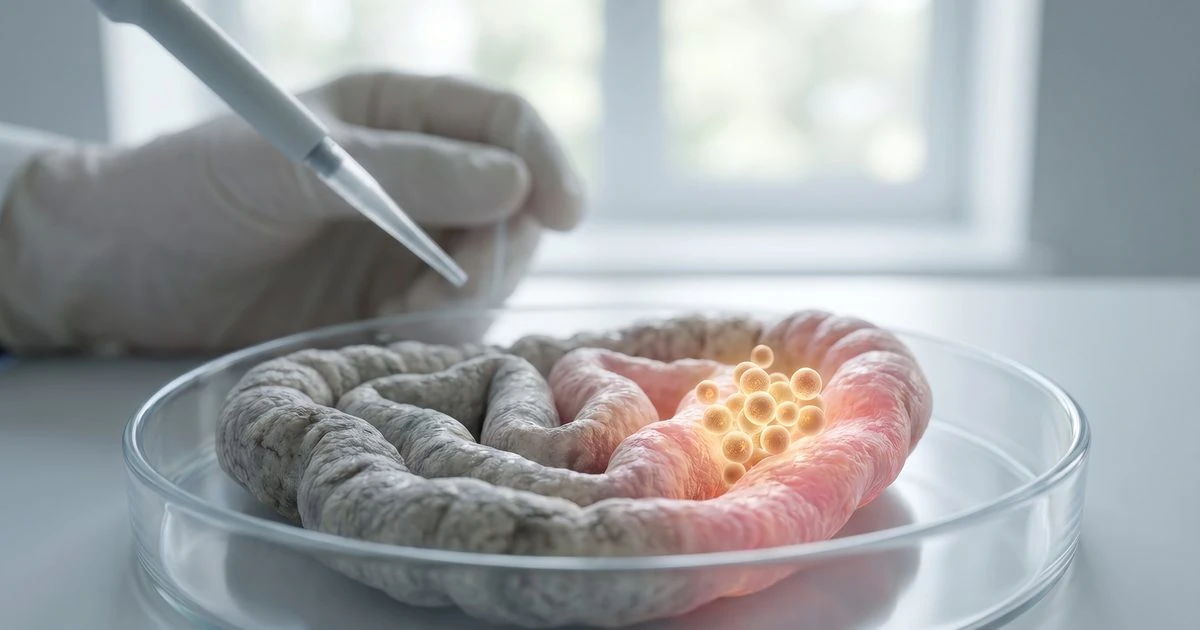
The intestinal lining is among the most relentlessly self-renewing tissues in the body, replacing itself every few days. That regenerative engine depends on intestinal stem cells (ISCs), and those cells lose power as we age. A study published in Stem Cell Reports by researchers at Cincinnati Children's Hospital Medical Center and Ulm University in Germany now offers an early explanation for why: aging-associated gut microbiota directly suppresses ISC activity, and swapping in a younger microbial community can restart the process.
Young Microbiota Restored Intestinal Stem Cell Activity in Aged Mice
The core experiment was straightforward in design. Researchers transferred gut bacteria from young mice into older mice, then tracked what happened to ISC activity. The results were striking: ISCs in the older animals, which had been significantly less active than those in young controls, began producing new tissue at a rate resembling younger gut biology. After injury, the gut lining of the older recipients also recovered more quickly than that of untreated aged mice. These are preliminary findings in an animal model, but they establish a direct causal link between microbial composition and the regenerative capacity of aging gut tissue.
The team identified specific molecular changes that explained the effect. Aged mice showed reduced signaling of the Ascl2 gene and dampened activity in the WNT pathway, both essential for ISC function. Pronounced shifts in bacterial species coincided with those suppressed signals. One bacterium stood out: Akkermansia muciniphila, which was more prevalent in the aged gut and appeared to suppress WNT signaling, effectively putting the brakes on gut regeneration.
Why a Slowing Gut Lining Matters for Infection, Inflammation, and Cancer Care
A gut that cannot renew itself efficiently is more than a digestive inconvenience. Impaired ISC activity leads to increased intestinal permeability (sometimes called leaky gut), reduced nutrient absorption, and heightened systemic inflammation, all of which are hallmarks of biological aging. Research on FMT improving frailty in aging mice has shown that altered gut microbiota composition in older animals is linked to chronic low-grade inflammation and a cascade of age-related conditions.
The clinical stakes extend well beyond general frailty. Patients undergoing radiation therapy for cancer often suffer serious damage to the intestinal lining, and recovery is slower and more complicated in older adults. Surgical patients face similar challenges when post-operative gut repair stalls. If microbial transplantation can prime ISCs to recover faster, the implications for oncology and surgical care could be significant. For now, that remains a hypothesis to be tested.
How the Team Pinned Bacteria as the Cause, Not Just a Correlate
The strength of this study lies in its use of fecal microbiota transfer (FMT) as a precise experimental tool, not as a therapy. By transferring a characterized microbial community from young donors to aged recipients, the researchers could isolate the effect of microbiome composition from the many other variables that change with aging. This is one reason mouse models remain valuable: human gut microbiome research is complicated by confounders like disease history, medication use, and dietary variation that make it difficult to untangle age-related microbiome changes from everything else.
The researchers monitored ISC activity after transfer, analyzed shifts in bacterial species composition, and traced the molecular pathway from specific bacteria to suppressed gene signaling. Identifying Akkermansia muciniphila as a potential suppressor of WNT signaling gives future researchers a concrete mechanistic target, rather than a vague correlation between old microbiomes and poor gut health.
Open Questions About Human Translation and Long-Term Safety
The gap between a promising mouse result and a clinical intervention is wide, and this study does not close it. The researchers are explicit: more work is needed before these findings can inform human gut rejuvenation strategies. Key unknowns include whether the same ISC reactivation occurs in humans, what the optimal donor species combination looks like, how to dose such a transfer safely, and what the long-term safety profile would be for elderly patients.
It is also worth noting what this research is not. Consumer probiotic supplements do not replicate the complex, diverse, and age-specific microbial shifts observed in controlled FMT experiments. The microbial communities used here were precisely characterized; a shelf-stable capsule with a handful of Lactobacillus strains is a fundamentally different intervention.
Clinical Trials Are Testing FMT in Older Adults, With Results Expected by 2027
The mouse findings arrive alongside genuine momentum in human trials. The ARMOR study, a randomized double-blind placebo-controlled trial, is testing FMT from young, physically active donors in adults aged 65 to 84, measuring outcomes including muscle function, grip strength, gait speed, cognitive performance, and gut microbiome composition. A separate trial from the Chinese Academy of Medical Sciences, STEP-aging, is recruiting participants to test FMT against biological aging markers and expects completion by late 2027.
A 2025 study in mSystems found that FMT from young to old mice improved grip strength, frailty scores, body composition, metabolic markers, and reduced neuroinflammation, lending broader context to the ISC findings. Researchers working on the future of FMT in aging therapy note that the field still faces significant hurdles around regulatory frameworks, protocol standardization, and defining which patient populations stand to benefit most.
For now, the most reliable way to support a diverse gut microbiome remains unglamorous: dietary fiber, a wide variety of plant foods, fermented foods, limited ultra-processed food, regular physical activity, and avoiding unnecessary antibiotic use. The new mouse data suggests that the microbial community living in your gut may shape how quickly your intestine repairs itself as you age. Establishing whether that is true in humans, and what to do about it, is the work of the next several years.
Evidence rating
INVESTIGATIONAL — 78/100
Caveats:
- This study was conducted entirely in mice — the stem cell reactivation effects have not yet been confirmed in humans.
- Funding source for the primary study is not disclosed in the available materials.
- Akkermansia muciniphila is generally considered beneficial in other contexts; its age-specific suppressive role on gut stem cells requires further investigation before drawing conclusions about supplementation.
- Human FMT trials for aging (ARMOR, STEP-aging) are underway but have not yet reported results — findings from mouse models may not translate directly.
Animal study using fecal microbiota transfer in mice. Demonstrates a step-by-step mechanistic link between gut microbiome composition, WNT/Ascl2 signaling, and intestinal stem cell activity, with Akkermansia muciniphila identified as a specific suppressive factor in aged guts. Results show association and proposed mechanism within the mouse model but cannot establish causation in humans; replication in human populations has not yet occurred. Funding source was not disclosed in available materials.

